
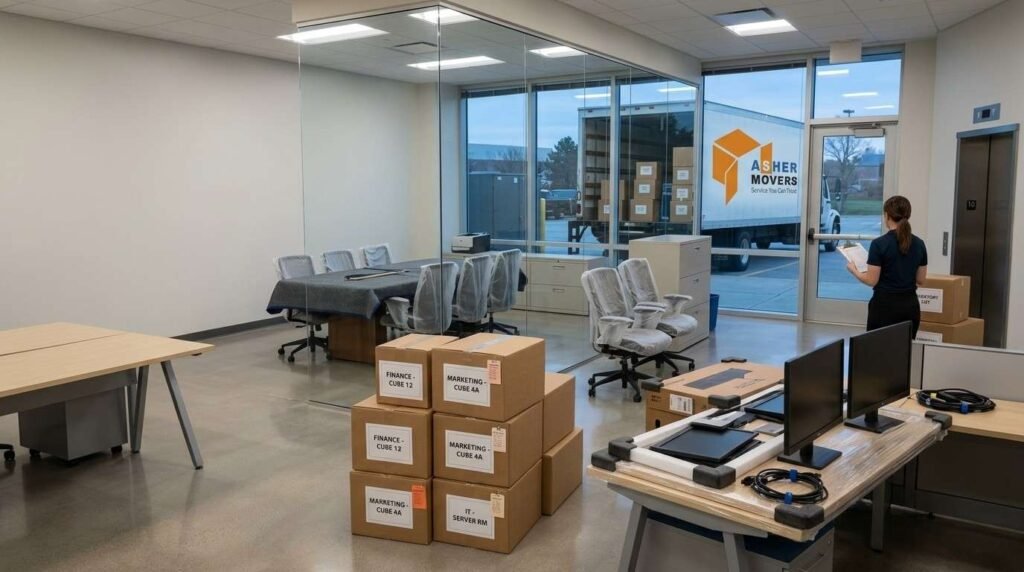
Moving an office is not the same as moving a house. A commercial move involves coordinating employees, IT equipment, furniture, and sometimes an entire operation schedule around a single moving day. I have seen businesses in Skokie try to treat an office relocation like a weekend apartment move, and it never goes smoothly.
Downtime costs money, misplaced files cause real problems, and prohibited items create last-minute scrambling. This guide walks you through every stage so nothing catches you off guard.
I will cover planning, packing rules, prohibited items, costs, and moving day logistics. By the end, you will know exactly what to expect and how to prepare.
What Commercial & Office Moving Actually Involves
A commercial move is the relocation of a business’s physical space, including furniture, equipment, documents, and technology infrastructure. It differs from a residential move because it touches operations, not just belongings. Every desk, server, and filing cabinet has a role in keeping the business running.
Office moves also involve more stakeholders. Employees need direction, IT needs a transition plan, and management needs the business back online fast. This is why commercial movers plan differently than they do for a home.
The scope typically includes desks, chairs, computers, servers, printers, conference room equipment, and sometimes specialized machinery. Businesses with sensitive data or regulated industries add another layer of care around document handling and chain-of-custody tracking.
How Office Moves Differ From Residential Moves
Residential moves center on personal belongings and a single household’s schedule. Commercial moves center on minimizing business interruption while relocating shared assets that many people depend on.
A home move can happen on a weekend with flexible timing. An office move usually happens after hours, overnight, or across a weekend specifically to avoid lost workdays.
How to Plan a Commercial or Office Move Timeline
Planning starts 8 to 12 weeks before the move date for most mid-sized offices. Larger operations with more departments or specialized equipment often need even more lead time. I always tell clients that early planning is the single biggest factor in a smooth move.
Start by creating an inventory of everything being relocated. Tag furniture, label boxes by department, and flag anything requiring special handling like server racks or lab equipment.
Communicate the timeline to every department early. Employees need to know when to pack personal items, when systems go offline, and when they can expect to be operational again at the new address.
Setting a Moving Date Around Business Downtime
Most businesses schedule moves over a weekend or during a slower operational period. This keeps IT downtime and productivity loss to a minimum.
Retail and client-facing businesses often move overnight to avoid disrupting customer access. Manufacturing and warehouse operations plan around production schedules instead.
What Movers Can and Cannot Transport in an Office Move
Movers cannot transport hazardous materials, perishable items, or certain high-value items without special arrangements. This rule protects both the moving crew and the business from liability and safety risks. Knowing this list before packing day prevents last-minute delays.
Every moving company follows federal and state transportation guidelines for what qualifies as non-allowable cargo. The U.S. Department of Transportation’s Federal Motor Carrier Safety Administration outlines hazardous materials classifications that carriers must follow, and commercial movers apply these same standards to office relocations, according to FMCSA’s hazardous materials safety program.
Commonly Prohibited Items in Commercial Moves
Flammable liquids, compressed gases, corrosive chemicals, and explosives top the prohibited list for any moving company. Cleaning supplies, certain lab chemicals, and aerosol cans also fall into this category.
Perishable food items and plants typically cannot go on long-distance moves due to spoilage and pest regulations. Businesses with break rooms or cafeterias need a separate plan for these items.
Personal firearms, ammunition, and certain valuable documents often require separate transport arrangements outside a standard moving contract.
Restricted Electronics, Equipment, and Hazardous Materials
Servers, batteries, and certain lab or medical equipment require special handling rather than an outright ban. Lithium batteries, for example, fall under stricter transport rules because of fire risk during transit.
Businesses with specialized machinery, like printing presses or medical devices, often need a separate specialty carrier. Standard commercial movers handle general office equipment but defer to experts for anything regulated or oversized.
How to Pack an Office or Commercial Space Properly
Proper office packing starts with labeling everything by department, room, and destination location. This single habit prevents more confusion on moving day than almost anything else. Color-coded labels work well for larger offices with multiple floors or departments.
Electronics need original boxes when possible, or anti-static bubble wrap and sturdy boxes when originals are unavailable. Cable management matters too. I always recommend photographing the back of workstations before disconnecting anything, so reconnection at the new site goes faster.
Furniture disassembly should happen a day or two before the move, not the morning of. This gives the moving crew a clear path and reduces the risk of damage during the rush.
Packing Sensitive Equipment, Files, and Furniture
Confidential documents need locked file boxes or crates, especially for businesses handling client data or regulated records. Chain-of-custody tracking matters for legal, medical, and financial offices moving sensitive files.
Server equipment should be backed up before the move regardless of physical precautions taken. Hardware can be replaced. Lost data usually cannot be.
Employee and Department Coordination During the Move
Assign a point person in each department to manage packing and communication for that team. This reduces the burden on a single office manager trying to coordinate an entire building alone.
Send a moving schedule to all staff at least two weeks before the date. Include what employees need to pack themselves versus what the moving crew handles.
Clear communication prevents the most common office moving complaint I hear: employees showing up without knowing where their new desk or department sits.
Understanding Commercial Moving Costs and Quotes
Commercial moving costs depend on square footage, distance, inventory volume, and any specialty item handling required. A small office move within Skokie runs differently than a cross-state relocation with server rooms and specialized equipment.
Most moving companies quote based on either an hourly rate for local moves or a weight and distance calculation for long-distance moves. Get itemized quotes from at least two or three companies before committing.
Ask about additional fees for stairs, elevators, long carry distances, and after-hours labor. These add-ons surprise businesses that only compared base hourly rates.
Choosing the Right Commercial Moving Company
Look for movers with specific commercial and office relocation experience, not just general residential moving history. Office moves involve different equipment, different insurance needs, and different scheduling pressures.
Verify licensing and insurance coverage before signing a contract. The Federal Motor Carrier Safety Administration requires interstate movers to register and carry specific insurance minimums, which you can verify directly through FMCSA’s company safety search tool.
Ask for references from other businesses of similar size. A moving company that handles retail storefronts well may not have the same experience with a law firm’s document-heavy relocation.
Minimizing Business Downtime and Disruption
Schedule the physical move for after-hours, weekends, or planned closure periods whenever the business allows it. This keeps operations running on the old schedule until the very last moment.
Set up critical infrastructure first at the new location. Internet, phone systems, and core servers should be operational before general furniture and desk setup begins.
Stagger the return-to-work schedule if the business is large. Not every department needs to be fully operational on day one.
Moving Day Logistics for Commercial Properties
Confirm elevator reservations and loading dock access at both the old and new locations well before moving day. Many commercial buildings require advance booking for freight elevators, and missing this step causes real delays.
Designate a move-day coordinator who stays on-site the entire time to answer crew questions and direct traffic between departments and floors.
Walk through both locations with the moving company beforehand. This single step catches access issues, parking restrictions, and building rules that could slow down the entire move.
Local vs. Long-Distance Office Moving Considerations
Local commercial moves within Skokie or the greater Chicago area typically complete within a single day or overnight window. Long-distance moves crossing state lines involve more regulatory requirements and longer transit windows.
Interstate commercial moves fall under federal transportation regulations, while local moves follow state-specific rules. Illinois requires movers to register with the Illinois Commerce Commission, and businesses can confirm a mover’s standing through the Illinois Commerce Commission’s licensed movers database.
Long-distance moves also require more advance planning for IT downtime, since equipment spends more time in transit and less time being actively managed.
Insurance, Liability, and Protecting Business Assets
Standard moving company liability coverage often falls short of covering the full replacement value of business equipment and inventory. Businesses should ask about full-value protection versus basic released-value coverage before the move.
Check whether the business’s existing commercial property insurance covers items in transit during a move. Some policies exclude this gap entirely, leaving valuable equipment unprotected for the exact window when damage risk is highest.
Document the condition of high-value items with photos before the move begins. This protects the business if a damage claim becomes necessary later.
Conclusion
Commercial and office moves succeed when planning, packing rules, and prohibited item awareness come together early. Every stage, from timeline to moving day logistics, connects directly to minimizing business disruption.
Costs, liability, and mover selection all shape how smoothly a relocation unfolds for any Skokie business. Long-distance or local, preparation determines the outcome.
We at ASHER MOVERS LOCAL & LONG DISTANCE handle commercial and office relocations with the planning and care your business deserves. Reach out to us to schedule a move that keeps your operation running.
Frequently Asked Questions
What items are movers not allowed to move during an office relocation?
Movers cannot transport hazardous materials, flammable liquids, compressed gases, or perishable food items. Firearms and certain valuable documents also require separate handling outside a standard contract.
How far in advance should a business plan an office move?
Most mid-sized offices need 8 to 12 weeks of planning before the move date. Larger operations with specialized equipment often need more lead time.
Can movers transport computers and servers?
Yes, standard commercial movers handle computers and servers with proper packing materials. Data should still be backed up beforehand since hardware damage remains a possibility.
How much does a commercial office move typically cost?
Costs depend on square footage, distance, and inventory volume, with local moves often quoted hourly. Long-distance moves use weight and distance-based pricing instead.
What is the best time to schedule an office move?
Weekends, overnight windows, or planned closure periods work best for minimizing business disruption. This keeps normal operations running until the last possible moment.
Do commercial movers handle furniture disassembly?
Most commercial moving companies disassemble and reassemble standard office furniture as part of the service. Confirm this detail during the quote process since policies vary by company.
What insurance coverage should a business have during a move?
Businesses should ask about full-value protection rather than basic released-value coverage from the mover. Checking existing commercial property insurance for transit gaps is also worthwhile.
How is a long-distance office move different from a local one?
Long-distance moves involve federal transportation regulations and longer transit windows than local moves. Local moves within Illinois follow state registration rules instead.
