
I’ve watched hundreds of Skokie families stare at a spreadsheet trying to decide between renting a truck and calling in professional movers. A true cost comparison between a DIY local move and hiring movers accounts for truck rental, supplies, fuel, insurance, lost wages, and injury risk, not just the sticker price of a rented van versus an hourly moving crew. Most people only compare the obvious numbers and miss the rest entirely.
That gap in the math costs people real money, and sometimes real injuries, every single week. I want to walk through what actually belongs in this comparison before you commit to either path.
This guide covers how to define a true cost comparison in the first place, what DIY moves and professional movers actually cost in Skokie, the hidden expenses most people forget, how liability and insurance change the equation, and how to figure out which option fits your specific move.
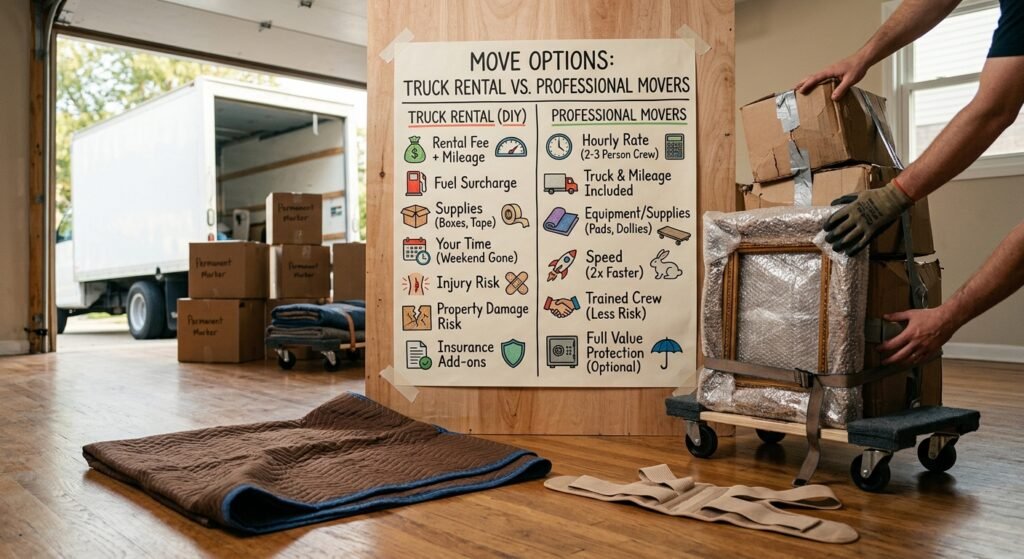
What a “True Cost” Comparison Actually Measures
A true cost comparison adds direct expenses like truck rental and movers’ fees to indirect costs like time, injury risk, and property damage that rarely show up on a receipt. Most online calculators only account for the first category.
I’ve seen people “save” $400 by renting a truck, then spend two sick days recovering from a thrown-out back. That’s not a savings. That’s a cost deferred to a worse moment.
Direct Costs vs. Hidden Costs
Direct costs are anything you pay for upfront: truck rental, fuel, movers’ hourly rate, packing tape. Hidden costs are the ones that surface later, like a cracked dresser, a strained muscle, or a half-day of missed work.
A fair comparison puts both categories side by side instead of treating the invoice as the whole story.
Why Hourly Rates Don’t Tell the Full Story
An hourly rate from a moving company looks expensive next to a flat truck rental fee, but speed changes the math fast. Professional crews typically move a household two to three times faster than an untrained group of friends, which shrinks the total hours billed.
I always tell people to multiply the hourly rate by realistic hours, not by the number that feels cheapest to imagine.
The Real Cost of a DIY Local Move in Skokie
A DIY local move in Skokie typically runs $350 to $900 once you account for truck rental, packing supplies, fuel, and basic insurance add-ons. That range swings heavily based on home size and how far you’re driving the truck.
I break this down into three cost buckets below because each one tends to get underestimated for a different reason.
Truck Rental Rates and Mileage Fees
Truck rental companies advertise a low daily rate, then tack on mileage charges, environmental fees, and a fuel surcharge that can double the quoted price. A 15-foot truck advertised at $29.95 a day commonly lands between $90 and $150 once mileage and fees are added.
Penske’s consumer rental pricing guide confirms that advertised base rates rarely reflect the final charge after mileage and insurance options are applied.
Packing Supplies and Equipment Costs
Boxes, tape, bubble wrap, furniture blankets, and a hand truck add up fast if you’re starting from zero. A typical 2-bedroom household spends $150 to $250 on packing materials alone when buying new supplies instead of sourcing used boxes.
Dollies and straps rented separately from the truck company can add another $30 to $60 to the total.
Fuel, Tolls, and Insurance Add-Ons
Fuel for a loaded moving truck burns noticeably more than a passenger car, and most rental companies require you to return the tank full or pay an inflated refueling charge. Basic damage waiver insurance on a rental truck typically adds $15 to $30 per day.
None of these line items look large individually. Stacked together, they often account for 30% of the total DIY moving cost.
The Real Cost of Hiring Local Movers in Skokie
Hiring local movers in Skokie typically costs $400 to $1,200 for a studio to 3-bedroom home, priced either hourly or as a flat rate depending on the company and distance. The final number depends heavily on crew size, home size, and how much packing help you need.
Two pricing models dominate this market, and they lead to very different budgeting conversations.
Hourly Labor Rates vs. Flat-Rate Pricing
Hourly local moving rates generally run $100 to $200 per hour for a two-to-three-person crew in the Chicago metro area, while flat-rate pricing bundles labor, truck, and mileage into one upfront number. Flat-rate pricing removes the guesswork but requires an accurate in-home or virtual survey beforehand.
I generally recommend flat-rate pricing for anyone who hates financial surprises on moving day.
What’s Typically Included in a Mover’s Quote
A standard local moving quote usually includes labor, truck usage, basic furniture pads, and released value protection at no extra charge. Extra packing materials, full-value protection, and specialty item handling are typically quoted separately.
Reading the fine print on exactly what’s bundled prevents the most common source of moving-day sticker shock.
Hidden Costs People Forget to Calculate
The biggest blind spot in any moving cost comparison is the cost of your own time and the risk of injury or damage, neither of which shows up on an invoice. These hidden costs often outweigh the visible price difference between DIY and hiring professionals.
I’ve watched this category single-handedly flip the “cheaper” option from DIY to hired movers more times than I can count.
Time Off Work and Lost Productivity
A DIY move realistically consumes an entire weekend, sometimes bleeding into a weekday for recovery or return trips with the rental truck. If your time is worth even $25 an hour and the move eats twelve hours of your Saturday, that’s $300 of opportunity cost nobody wrote on a receipt.
Business owners and hourly workers feel this hit hardest since missed work hours translate directly into missed income.
Property Damage Risk
Untrained movers scuff walls, chip stairwells, and crack furniture at a noticeably higher rate than trained crews carrying the right equipment. Repairing a single damaged wall or replacing one piece of furniture can erase any savings from skipping professional movers entirely.
The Value of Time: What Is a Day of Your Life Worth?
Calculating the value of your time means multiplying your hourly wage, or your hourly value as a business owner, by the hours a DIY move actually consumes. For most working adults, that number lands between $200 and $500 for a single moving day once planning, driving, and recovery are included.
I ask clients one question before they commit to DIY: what else could you have earned or accomplished with that same Saturday? That answer usually settles the decision faster than any spreadsheet.
Physical Risk and Injury Costs in DIY Moves
Lifting heavy furniture without proper technique or equipment is a leading cause of back injuries, pulled muscles, and joint strain during self-managed moves. An urgent care visit for a moving-related strain commonly runs $150 to $300 out of pocket before insurance, not counting missed work during recovery.
Professional movers train specifically in lifting technique and use equipment like forearm forklifts and furniture dollies that most households don’t own. That training gap is exactly why injury rates differ so sharply between the two groups.
Liability and Insurance Differences
Liability coverage determines who pays when something breaks, and DIY movers carry almost none of it compared to a licensed moving company. This single factor often decides which option is actually cheaper once something goes wrong.
Released Value Protection vs. Full Value Protection
Released value protection, required by federal regulation, covers damaged goods at 60 cents per pound regardless of actual item value, while full value protection covers the item’s full repair or replacement cost for an added fee. The Federal Motor Carrier Safety Administration requires movers to offer both options in writing before a move.
A DIY move carries neither protection unless you purchase separate renter’s insurance coverage for the moving day itself.
How Distance and Home Size Change the Math
Home size and trip distance shift the cost comparison more than any other variable, since both truck rental fees and mover labor hours scale directly with how much you own and how far it travels. A studio apartment and a four-bedroom house are not the same financial decision.
Studio and 1-Bedroom Moves
A studio or 1-bedroom local move typically costs $200 to $400 DIY versus $300 to $500 hired, a gap small enough that convenience often tips the decision toward professional movers. The lighter the load, the less the labor-hour difference matters.
3+ Bedroom Home Moves
A 3-bedroom or larger home move can run $600 to $900 DIY versus $900 to $1,500 hired, but the DIY number assumes zero injuries, zero damage, and a full weekend of unpaid labor from friends or family. Larger homes are where hidden costs compound fastest.
Equipment and Specialty Item Handling Costs
Specialty items change the cost comparison because they require equipment and expertise most households don’t have on hand. Pianos, safes, and oversized appliances are the items most likely to cause injury or damage in a DIY move.
Furniture Dollies, Straps, and Blankets
Furniture dollies, forearm straps, and moving blankets rent for roughly $20 to $50 for a weekend if you don’t already own them, and improper use of straps is a common cause of dropped furniture and injury. Professional crews bring this equipment included in their rate.
Moving Pianos, Safes, and Large Appliances
Moving a piano or a home safe without specialized equipment risks injury severe enough to require emergency care, and most moving companies quote these items separately due to the equipment and crew size required. DIY movers attempting these items without help account for a disproportionate share of moving-day injury reports.
DIY Move Cost Breakdown: A Sample Scenario
A 2-bedroom DIY move in Skokie covering 10 miles typically totals $520 once every cost category is added together. Here’s how that number breaks down in practice.
| Cost Category | Amount |
| Truck rental + mileage | $140 |
| Packing supplies | $180 |
| Fuel and insurance add-on | $60 |
| Lost time (8 hours at $20/hr value) | $160 |
| Total | $520 |
That total excludes any injury or damage costs, which would push the number considerably higher if they occur.
Hiring Movers Cost Breakdown: A Sample Scenario
A 2-bedroom hired move in Skokie covering the same 10 miles typically totals $650 with a standard three-person crew and basic coverage included. The breakdown looks different because labor replaces your own time.
| Cost Category | Amount |
| Labor (3 movers, 3 hours) | $450 |
| Truck and mileage | $150 |
| Packing materials (partial) | $50 |
| Total | $650 |
The $130 gap between these two scenarios shrinks or disappears entirely once lost time, injury risk, and damage probability are factored into the DIY column.
When DIY Actually Makes Financial Sense
A DIY move makes the most financial sense for small apartments, short distances under five miles, and movers with flexible schedules who don’t mind physical labor. Students and single renters with minimal furniture are the clearest candidates for this path.
I tell people with fewer than 15 boxes and no furniture heavier than a couch that DIY is a reasonable call.
When Hiring Movers Is the Smarter Investment
Hiring movers becomes the smarter investment for larger homes, tight timelines, physically demanding items, and anyone whose daily income exceeds the labor cost difference. Families with children or pets also benefit from the speed a trained crew provides.
Once a move involves stairs, a piano, or more than two bedrooms, the math consistently favors professional help.
Common Cost-Cutting Mistakes That Backfire
The most expensive mistake in moving cost planning is choosing the cheapest option without pricing in time, injury risk, or damage probability. Skipping insurance to save a few dollars is the second most common mistake, and it’s the one people regret fastest.
Borrowing unlabeled boxes and skipping furniture padding to save money also drives up the odds of damage that costs more to fix than the padding would have cost to buy.
How to Get an Accurate Moving Cost Estimate
Getting an accurate estimate requires either an in-home survey or a detailed virtual walkthrough so the mover can quote your actual inventory rather than a rough guess. A phone estimate without seeing your belongings is the single biggest cause of day-of price surprises.
In-Home vs. Virtual Surveys
In-home surveys involve a representative walking through your home and cataloging items in person, while virtual surveys use a video call to achieve similar accuracy without a scheduling visit. Both methods produce far more reliable quotes than a phone call based on room count alone.
I recommend virtual surveys for most Skokie households since they take fifteen minutes and produce a binding quote without anyone stepping into your living room.
Conclusion
A true cost comparison weighs truck rental, supplies, and hourly labor against time, injury risk, and liability together. Skokie movers face real tradeoffs depending on home size, distance, and schedule flexibility.
We’ve seen both paths work when matched to the right situation and household needs. Reach out to ASHER MOVERS LOCAL & LONG DISTANCE for a free, accurate quote before you decide.
Frequently Asked Questions
Is it cheaper to move yourself or hire movers for a local move?
For small apartments, DIY is often cheaper by $100 to $300. For 2-bedroom homes and larger, hiring movers frequently costs about the same or less once time and injury risk are included.
How much does a local move cost in Skokie, IL?
Local moves in Skokie typically range from $350 to $1,500 depending on home size and whether you hire movers or rent a truck yourself. Distance and specialty items also affect the final price.
What does released value protection cover in a move?
Released value protection covers damaged items at 60 cents per pound, regardless of their actual value. It’s the minimum federally required coverage movers must offer at no extra cost.
How many hours does a 2-bedroom move typically take with professional movers?
A 2-bedroom move with a three-person crew typically takes two to four hours depending on stairs, distance, and packing status. Pre-packed homes move noticeably faster than ones packed on moving day.
What items do movers charge extra to transport?
Movers commonly charge extra for pianos, safes, pool tables, and oversized appliances due to the specialized equipment and crew size required. These items should always be mentioned during your initial quote.
Can I rent moving equipment like dollies and straps separately?
Yes, most truck rental companies and hardware stores rent dolls, straps, and furniture blankets for a daily fee. Renting this equipment is far cheaper than risking injury or damage without it.
Should I get an in-home or virtual moving estimate?
A virtual estimate is usually sufficient for most households and takes about fifteen minutes over video call. In-home estimates are better suited for larger homes with unusual layouts or high-value items.
