
Moving day in Skokie, IL comes with a specific set of rules around what professional movers can legally load onto a truck, and food, plants, and pets fall into the most commonly misunderstood category. Movers restrict these items because of spoilage risk, agricultural regulations, and animal safety liability, not arbitrary policy.
I’ve seen plenty of moving days get delayed by a single unprepared box. A pantry shelf packed at the last minute or a pet left loose near the loading ramp creates real problems fast.
This guide covers what movers can and cannot take, how to pack food and pantry items correctly, what to do with houseplants on a local versus long-distance move, how to keep pets safe during loading, and the hazardous materials that never belong on the truck.
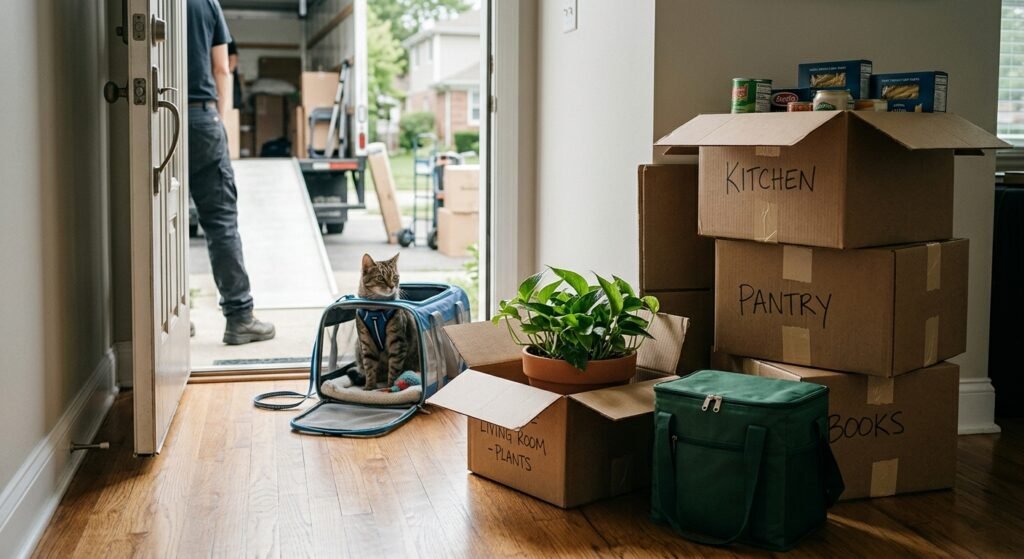
What Movers Can and Cannot Transport on Moving Day
Movers generally cannot transport hazardous materials, perishable food without proper preparation, live plants over state lines, or pets inside the moving vehicle. These restrictions exist because moving companies carry liability insurance that excludes damage or loss tied to spoilage, contamination, or live cargo.
I always tell clients the easiest way to think about restricted items is by risk category: things that leak, things that die, things that combust, and things that breathe. Each category gets handled differently on moving day.
Why Movers Restrict Certain Household Items
Movers restrict certain household items because insurance policies will not cover damage from spoiled food, crushed plants, or an injured animal inside a sealed truck. A mover’s liability coverage protects boxed household goods, not biological or combustible materials.
Every moving company I’ve worked alongside builds its own item list around state transportation law and its own insurance carrier’s terms.
Packing Food for a Local Move in Skokie, IL
Perishable food should be consumed, donated, or transported separately in a cooler on a local move, while non-perishable pantry items can typically be boxed and loaded with the rest of the household goods. The short distance of a local Skokie move gives families more flexibility than a long-distance relocation would.
I usually recommend treating the kitchen like its own mini-project a few days before the move. Sorting food early avoids a frantic last-minute decision about what to toss.
Perishable vs. Non-Perishable Food Guidelines
Perishable food includes anything that spoils without refrigeration within a few hours, while non-perishable food covers canned goods, dry pasta, and sealed packaged items that tolerate hours in a truck without temperature control. Non-perishable pantry stock is the easiest food category for movers to load, since it behaves like any other boxed household good.
I pack non-perishables in smaller boxes than people expect. Canned goods get heavy fast, and an overloaded box tears at the bottom before it even reaches the truck.
Refrigerated and Frozen Food Transport Rules
Refrigerated and frozen food rarely survives a move inside a standard moving truck, since trucks have no climate control and even a short Skokie drive can take long enough for frozen goods to thaw. Most movers recommend transporting refrigerated items in a cooler in a personal vehicle instead of the truck.
I’ve watched families try to time a move around finishing the freezer first. It almost always works better than packing it.
Canned Goods, Pantry Items, and Liquids
Canned goods and sealed pantry items are generally allowed on the moving truck, but open liquids and partially used containers create spill risk that most movers won’t take responsibility for. A pantry inventory sorted by container type speeds up the loading process considerably.
I group these into two piles before a move: sealed and unsealed. Anything unsealed either gets used up, tossed, or hand-carried separately.
Moving Alcohol and Open Food Containers
Open food containers and partially consumed liquids are typically declined by movers due to spill and contamination risk inside a shared truck space. Unopened alcohol bottles usually travel fine on a local move, though interstate alcohol transport carries its own set of state-specific regulations movers must follow.
I always have clients seal and tape any bottle that’s already been opened, or just pack it in a personal cooler bag instead of a moving box.
Moving Houseplants on Local Moving Day
Houseplants can usually travel on a local moving truck in Skokie, IL, since short-distance moves don’t cross the state agricultural boundaries that create legal restrictions on plant transport. Movers still treat plants differently from boxed items because they’re fragile, living cargo that needs airflow and upright positioning.
I personally load plants last and unload them first. They’re the one item on the truck that can’t wait in a hot or cold space for long.
Why Movers Limit Plant Transport
Movers limit plant transport because soil can spill, leaves bruise easily under weight, and extreme truck temperatures kill a plant faster than almost any other household item. Most moving companies will transport plants on a local move but ask the customer to acknowledge the fragility risk in writing.
I treat moving like moving a live animal in miniature. It needs its own space, not a shelf between two boxes.
How to Prepare Plants for a Short-Distance Move
Plants should be watered lightly a day before the move, placed in sturdy open-top boxes, and positioned upright with stems supported to prevent breakage during loading. A properly prepared plant survives a local move with minimal stress compared to one tossed loose into the truck.
I skip watering the morning of the move every time. Wet soil adds weight and makes the box collapse faster than dry soil does.
Long-Distance Plant Moving Restrictions
Long-distance plant moving restrictions exist because many states enforce agricultural inspection laws that prohibit bringing live plants across state lines without certification. Illinois and neighboring states both regulate certain plant species to prevent the spread of pests and invasive plant disease.
I tell every long-distance client the same thing: check the destination state’s agricultural department before assuming a plant can travel with the rest of the household.
Moving Pets Safely on Moving Day
Pets need their own transportation plan on moving day since professional movers cannot legally carry live animals inside the moving truck. Keeping pets in a quiet, contained space away from the loading zone reduces stress for the animal and removes a tripping hazard for the moving crew.
I’ve seen escaped pets cause more moving-day delays than any packing mistake. A scared animal near an open truck door is a genuine safety risk.
Preparing Dogs and Cats for Moving Day
Dogs and cats do best when confined to a single closed room with food, water, and familiar bedding while the rest of the house gets loaded. A pet left loose during a move is far more likely to bolt through an open door than one kept in a contained space.
I recommend a sign taped to that room’s door too. It sounds small, but it stops a well-meaning helper from opening it by accident.
Small Pets, Birds, and Aquariums
Small pets, birds, and aquariums each need individual handling, since aquarium water sloshes during transport and bird cages require stable temperatures and minimal jostling. Fish often travel better in sealed bags with minimal water than inside a full, sloshing tank.
I drain aquariums down to a travel-safe level before any local move. A full tank is one of the heaviest, least stable things in any house.
Why Movers Cannot Transport Pets in the Moving Truck
Movers cannot legally transport pets in the moving truck because trucks lack climate control, ventilation, and restraint systems required to keep an animal safe during transit. Most moving company insurance policies also explicitly exclude coverage for live animals, which places full liability on the customer if a pet were transported this way.
I explain this to new clients the same way every time: the truck is built for boxes, not breathing cargo.
Hazardous Materials and Other Non-Allowable Items
Hazardous materials such as propane tanks, paint, cleaning chemicals, and aerosols are prohibited on moving trucks due to combustion and spill risk in an enclosed space. Movers typically provide a written list of banned hazardous items before moving day so customers can dispose of or relocate them separately.
I always ask clients to walk their garage and basement with that list in hand. Those two spaces hide most of the hazardous surprises.
Common Household Hazardous Materials
Common household hazardous materials include propane, gasoline, motor oil, paint thinner, pool chemicals, fireworks, and ammunition. Nearly all of these items are restricted because they’re flammable, corrosive, or pressurized, and a single leak can damage every box around it.
I keep a running list on my phone for every move now. It saves a last-minute scramble through the garage shelf by shelf.
Creating a Pre-Move Checklist for Food, Plants, and Pets
A pre-move checklist separates belongings into categories days before moving day: perishable food to use up, pantry items to box, plants to prepare, pets to arrange care for, and hazardous materials to dispose of properly. Sorting by category rather than by room keeps the entire process more manageable.
I build this checklist two weeks out, not two days out. The extra lead time removes almost all of the moving-day pressure.
Common Moving-Day Delays Caused by Improper Preparation
Improper preparation of food, plants, pets, or hazardous materials is one of the most frequent causes of moving-day delays, since movers must stop to address an unexpected item rather than continuing the loading schedule. A single prohibited item discovered mid-load can push back an entire day’s timeline for everyone involved.
I’ve had crews lose thirty minutes over one leaking bottle of cleaning solution. It’s rarely the big items that cause delays, it’s the small overlooked ones.
Local vs. Long-Distance Moving Day Differences for These Items
Local moves in Skokie, IL generally allow more flexibility with plants and short-term food storage since the truck spends less time in transit, while long-distance moves face stricter plant regulations and require more deliberate food disposal planning. Distance changes the risk calculation for nearly every item on this list.
I plan long-distance moves around these restrictions from day one, while local moves get a lighter version of the same checklist.
Conclusion
Food, plants, and pets each follow different rules on moving day, shaped by spoilage risk, agricultural law, and animal safety liability. Understanding these categories early prevents delays and keeps the household goods move running smoothly from start to finish.
We’ve guided Skokie families through this exact preparation process for years, across both local and long-distance relocations. Reach out to ASHER MOVERS LOCAL & LONG DISTANCE to plan a move that accounts for every item in your home.
Frequently Asked Questions
Can movers transport my refrigerator with food inside?
No, movers require refrigerators to be emptied and defrosted before loading. Food left inside risks spoilage, leaks, and damage to surrounding boxes during transit.
Will movers take my houseplants on a local move?
Yes, most movers transport houseplants on local moves since no state line is crossed. Long-distance moves face stricter agricultural restrictions on live plants.
Can I put my pet in the moving truck with my belongings?
No, movers cannot transport pets inside the truck due to safety and insurance restrictions. Pets should travel separately in a personal vehicle or with a pet transport service.
What food items are movers not allowed to pack?
Movers typically won’t pack perishable, refrigerated, or frozen food items. Open liquids and partially used containers are also commonly declined due to spill risk.
Do I need to throw away open food containers before moving?
Yes, open food containers should be used up, discarded, or hand-carried separately before moving day. Movers generally decline opened items due to contamination and spill concerns.
How far in advance should I prepare plants for moving day?
Plants should be prepared one to two days in advance with light watering and sturdy boxing. Preparing too early or watering heavily right before the move increases damage risk.
What happens if movers find a prohibited item in a box?
Movers typically set the item aside and continue loading the rest of the shipment. This can cause minor delays, which is why pre-move sorting matters.
