
Mountain town moving is the process of relocating household or business belongings in or around elevated, terrain-restricted communities like Skokie’s surrounding foothill areas, where steep driveways, seasonal weather, and limited truck access change how movers plan and execute the job. I’ve worked alongside moving crews long enough to know these moves rarely go exactly like a flatland relocation. We put this guide together because the complications that trip people up a propane tank nobody flagged, a driveway too narrow for a 26-foot truck, a snowstorm that shows up two days early are almost always preventable.
Getting this wrong costs more than money. It costs you your moving date, your deposit, and your patience.
This guide covers what separates mountain moves from standard relocations, the climate and terrain packing requirements specific to elevation, the full list of items movers legally cannot transport, how zoning and seasonal timing affect your schedule, and the cost and insurance factors unique to mountain communities.
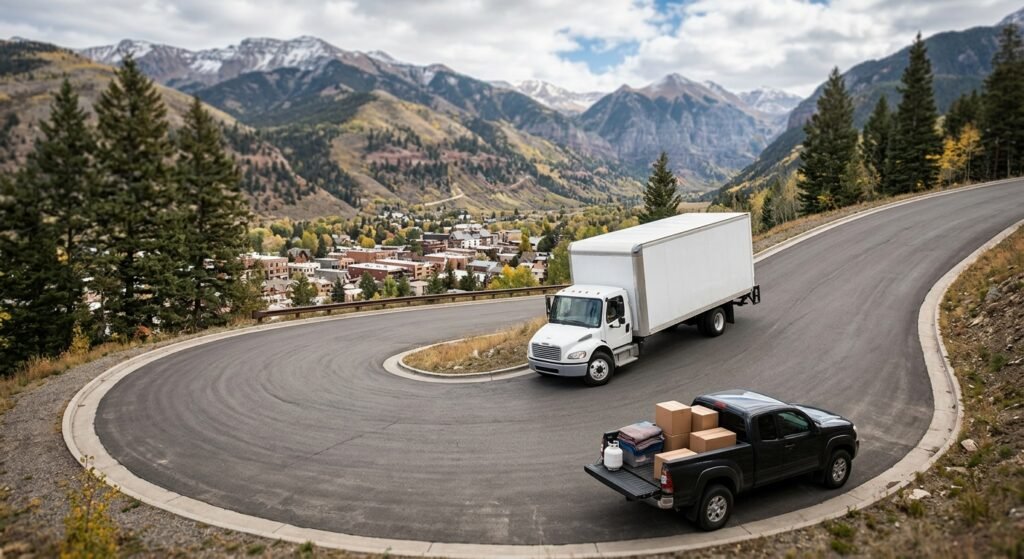
What Makes Mountain Town Moves Different From Flatland Moves
Mountain town moves differ from flatland moves primarily because of restricted road access, elevation-driven weather unpredictability, and property layouts that weren’t designed with large moving trucks in mind. A 26-foot truck that handles a suburban cul-de-sac without issue can become completely stuck on a switchback driveway with a 12% grade.
Elevation changes bring real logistical weight. Movers factor in thinner air affecting engine performance on long hauls, temperature drops of 20+ degrees between a town center and a property a few hundred feet higher, and access roads that get closed without warning during storms.
Elevation, Terrain, and Access Challenges
Properties built into hillsides often require moving crews to shuttle items using smaller vehicles before transferring them to the main truck parked at a safer distance. Switchback driveways, unpaved access roads, and gravel surfaces all limit which trucks can physically reach a front door.
I’ve seen crews park a truck a quarter-mile away and relay boxes by hand because the final stretch of road simply wasn’t rated for a loaded vehicle’s weight.
Seasonal Weather Windows Unique to Mountain Regions
Mountain weather shifts fast, and a clear morning can turn into a closed mountain pass by early afternoon. Movers scheduling mountain town relocations build in buffer windows that flatland moves never need, because a single unexpected snowfall event can push a move back by days rather than hours.
We always recommend booking shoulder-season dates when possible late spring or early fall since they carry the lowest risk of a weather-driven reschedule.
How Steep Driveways and Narrow Roads Affect Moving Day
Steep driveways and narrow roads limit which size of moving truck can safely reach a property, which is why many mountain town moves require a smaller shuttle vehicle for the final approach. Movers assess driveway grade, road width, and turning radius before moving day, not on it.
A driveway under 12 feet wide often can’t accommodate a full-size moving truck alongside parked cars or snowbanks. Crews that scout the route in advance avoid the costly surprise of arriving at a property they can’t actually reach.
If your home sits above a grade steeper than most residential streets, flag it when booking so the company can assign the right size vehicle from the start.
Packing Requirements for Mountain Climate Conditions
Mountain climate packing requirements center on protecting belongings from temperature extremes, humidity swings, and altitude-related pressure changes that don’t apply at sea level. Items that pack safely for a cross-town move in Skokie can suffer real damage on a mountain relocation if they’re not prepared differently.
Cold exposure during loading and transit affects electronics, liquids, and certain plastics more than people expect. We’ve seen bottled liquids freeze and expand inside moving boxes, cracking containers and soaking everything nearby.
Protecting Items From Temperature Swings
Temperature swings between a warm house and a freezing truck bed stress wood furniture, musical instruments, and anything with adhesive components like veneer or laminate. Wood furniture packing benefits from an acclimation period before loading, since sudden cold exposure can cause splitting that isn’t visible until weeks later.
Wrapping items in moisture-resistant materials before they ever leave a climate-controlled room reduces this risk substantially.
Moisture and Altitude-Sensitive Belongings
Altitude changes affect sealed containers, pressurized items, and anything with trapped air pockets. A sealed jar that’s fine at sea level can bulge or even pop at several thousand feet of elevation change during transport.
Musical instruments, wine collections, and vacuum-sealed storage bags all need extra attention before a mountain move, since humidity and pressure shifts hit these items hardest.
Items Movers Cannot Transport in Mountain Towns
Movers cannot legally transport hazardous materials, flammable liquids, corrosive chemicals, and certain pressurized containers regardless of location, and mountain town homes tend to have more of these items on hand than typical suburban households. Propane tanks, kerosene heaters, and firewood stockpiles are common in mountain properties and each carries its own handling restriction.
| Prohibited Category | Common Mountain-Town Examples | Why It’s Restricted |
| Flammable liquids | Propane, kerosene, gasoline, lighter fluid | Combustion risk in enclosed truck |
| Pressurized containers | Propane tanks, aerosol cans, oxygen tanks | Pressure change risk, explosion hazard |
| Corrosives | Pool chemicals, drain cleaner, car batteries | Leak and chemical burn risk |
| Organic/perishable | Firewood with pests, fresh produce | Contamination and infestation risk |
| Weapons/ammunition | Firearms, loose ammunition | Legal transport restrictions |
Hazardous and Combustible Materials
Combustible materials top the restricted list because enclosed moving trucks have no ventilation and sit parked for hours during loading and transit. Paint thinner, cleaning chemicals, and fireworks all fall under this category regardless of how small the quantity is.
A single leaking container can damage every other item in the truck, which is why movers decline these items outright rather than making exceptions.
Propane, Fuel, and Pressurized Containers (Common in Mountain Homes)
Propane tanks attached to grills, heaters, or RVs show up constantly on mountain town moving jobs because many properties rely on propane for heating or cooking. Propane tank transport requires the tank to be fully emptied, disconnected, and often transported separately by the homeowner rather than the moving truck.
Fuel-powered equipment like generators and snowblowers needs its tank fully drained before loading day, since even trace fuel vapor counts as a hazardous condition inside a sealed truck.
How to Prepare Belongings for Steep or Limited-Access Properties
Preparing belongings for steep or limited-access properties means consolidating smaller loads, labeling boxes for shuttle transport, and confirming a staging area where a smaller vehicle can meet the main truck. This prep step matters more on mountain properties than almost anywhere else, because crews often can’t simply back a truck up to the door.
We ask homeowners to clear a flat staging zone near the entrance, even if it’s just a cleared section of driveway or yard, so boxes have somewhere to land during the relay process.
Keeping fragile and heavy items in smaller, clearly labeled boxes speeds up the shuttle process considerably, since crews are often hand-carrying loads a greater distance than usual.
Snow, Ice, and Seasonal Timing Considerations for Moving
Snow and ice conditions directly affect whether a mountain town move can proceed as scheduled, since icy driveways and blocked mountain passes create safety risks that flatland moves rarely encounter. Winter moves in mountain regions require more flexible scheduling and often a backup date built into the original booking.
Roads that are perfectly passable in a passenger car can be unsafe for a loaded moving truck, particularly on descents where braking distance matters more with heavy cargo.
Many moving companies apply seasonal surcharges or require salt and sand treatment on private driveways before a winter move, and confirming this responsibility in advance avoids a same-day dispute.
Booking during late spring through early fall significantly reduces weather-related rescheduling, though summer afternoon thunderstorms in mountain regions can create their own short-notice delays.
Specialty Packing for Mountain Home Belongings
Specialty packing for mountain homes addresses items that don’t come up often in standard relocations, like outdoor equipment, firewood, and altitude-sensitive electronics. Mountain properties tend to have more outdoor and seasonal gear than typical suburban homes, which changes what a packing checklist actually needs to cover.
Firewood, Propane Tanks, and Outdoor Equipment
Firewood often can’t be transported across certain regional boundaries due to pest and invasive species regulations, something many homeowners don’t realize until moving day. Outdoor equipment like snowblowers, generators, and propane heaters each need fuel drained and components secured before loading.
Skis, snowshoes, and other seasonal gear pack easily but benefit from being grouped together and labeled clearly, since they’re often needed again sooner than boxed household items.
Fragile Décor and Altitude-Sensitive Electronics
Fragile décor common in mountain homes, like glass-blown ornaments or ceramic pieces, needs extra cushioning for the temperature swings and vibration of mountain road transport. Electronics with sealed components, including some older television models and specialty audio equipment, can experience pressure stress during significant elevation changes.
Wrapping these items in insulated, moisture-resistant packing materials before the truck ever leaves gives them the best chance of arriving intact.
Moving Trucks and Equipment Limitations on Mountain Terrain
Moving truck limitations on mountain terrain come down to weight restrictions on steep grades, turning radius on narrow roads, and ground clearance on unpaved or snow-covered driveways. A fully loaded truck handles differently on a 10% grade than it does on flat ground, and movers factor this into both vehicle selection and route planning.
Companies experienced in mountain town logistics typically maintain a mix of truck sizes, including smaller box trucks specifically for shuttle runs on properties the main truck can’t reach.
Four-wheel-drive support vehicles become essential during winter months, when even a well-maintained access road can turn hazardous within a few hours of snowfall.
Residential vs. Commercial Moves in Mountain Communities
Residential and commercial moves in mountain communities face similar terrain challenges but differ sharply in scheduling flexibility and equipment needs. Commercial moves often involve specialized equipment, tighter timelines tied to lease dates, and building access restrictions that residential moves don’t typically encounter.
A small mountain-town business relocating inventory and office equipment needs loading dock access or a confirmed staging plan well before moving day, since many mountain commercial buildings weren’t designed with large trucks in mind.
Residential moves generally offer more scheduling flexibility, which matters when weather windows are unpredictable and a backup date becomes necessary.
How Mountain Town Zoning and HOA Rules Affect Moving Day
Zoning and HOA rules affect moving day by restricting truck size, parking duration, and permitted moving hours in certain mountain neighborhoods. Some communities require advance notice before a moving truck can park on a shared access road, and violating these rules can result in fines or a blocked move.
Checking with a property’s HOA or local zoning office before booking a move date prevents a scenario where a truck arrives and can’t legally park where it needs to.
Avoiding Delays and Complications on Moving Day
Avoiding delays on moving day starts with confirming truck access, flagging restricted items in advance, and building weather flexibility into the schedule rather than treating the booked date as fixed. Most mountain-town moving complications trace back to information that wasn’t shared with the moving company until the truck was already on site.
A short pre-move walkthrough, even a phone call describing the driveway grade and any propane equipment, lets a moving company assign the right truck and crew size from the start.
Clear communication about access challenges consistently prevents the costliest kind of delay: a truck that simply can’t complete the job as originally planned.
Insurance, Liability, and Valuation Coverage for Mountain Moves
Insurance and valuation coverage for mountain moves work the same way as standard relocations but carry added relevance given the higher risk of transit damage from terrain and temperature extremes. Released value protection, the free coverage included by default, typically covers items at a fraction of their actual value.
Full value protection covers repair, replacement, or cash value for damaged items and costs more upfront but matters more on mountain routes where temperature swings and rough terrain raise the odds of transit damage.
Confirming which coverage level applies to specialty items like musical instruments or wine collections avoids an unpleasant surprise if something arrives damaged.
Choosing a Moving Company Experienced in Mountain Town Logistics
Choosing a moving company experienced in mountain town logistics means verifying they’ve handled steep-access properties before, not just assuming any licensed mover can manage the terrain. A company unfamiliar with switchback driveways or seasonal road closures can underestimate the job and show up without the right equipment.
Asking directly about past mountain-area jobs, available truck sizes, and winter scheduling policies gives a clearer picture than a generic moving quote ever will.
Local vs. Long-Distance Moves in Mountain Regions
Local moves within a mountain region typically involve shorter transit but face the same terrain restrictions as long-distance moves, while long-distance mountain moves add route planning around mountain passes that may close seasonally. A move crossing from a valley town into a higher-elevation community can encounter weather conditions the origin point never experiences.
Long-distance mountain moves benefit from extra scheduling buffer, since a single closed pass can add hours or even a full day to transit time.
Cost Factors Specific to Mountain Town Relocations
Cost factors specific to mountain town relocations include shuttle vehicle fees, seasonal surcharges, and additional labor time for properties requiring hand-carried loads over long distances. A move that would cost a flat rate on level ground often runs higher once terrain-related labor is factored in.
Getting a detailed, terrain-aware quote upfront one that accounts for driveway grade and access distance avoids cost surprises that generic flat-rate quotes tend to miss.
Conclusion
Mountain town moving comes down to terrain, climate, and timing working together, and understanding prohibited items keeps your move compliant and damage-free.
Every mountain relocation benefits from experienced planning around access, weather, and specialty packing needs specific to elevation.
We’ve built our process around these exact challenges, and ASHER MOVERS LOCAL & LONG DISTANCE is ready to help you move with confidence.
Frequently Asked Questions
What items are movers not allowed to transport?
Movers cannot transport hazardous materials, flammable liquids, corrosive chemicals, and pressurized containers like propane tanks. These restrictions apply to every move regardless of distance or location.
How do I prepare for a move during mountain winter conditions?
Preparing for a winter mountain move means booking flexible dates and confirming driveway accessibility in advance. Salt or sand treatment on steep driveways also helps crews work safely.
Can movers access homes on steep or unpaved driveways?
Movers often use smaller shuttle vehicles to reach homes on steep or unpaved driveways that full-size trucks can’t navigate. Flagging driveway conditions during booking ensures the right equipment arrives.
How far in advance should I book a mountain town move?
Mountain town moves should be booked four to six weeks ahead, especially during winter months. This buffer accounts for weather-related scheduling flexibility.
Do mountain moves cost more than flatland moves?
Mountain moves often cost more due to shuttle vehicle fees, seasonal surcharges, and added labor for hand-carried loads. Terrain-aware quotes reflect these factors upfront.
What should I do with propane tanks or firewood before moving?
Propane tanks must be emptied and disconnected before a move, and firewood often can’t cross certain regional boundaries. Checking with your mover in advance prevents last-minute complications.
Does moving insurance cover items damaged on steep terrain?
Standard released value coverage protects items at minimal rates, while full value protection covers repair or replacement cost. Mountain routes carry higher transit risk, making full coverage worth considering.
