
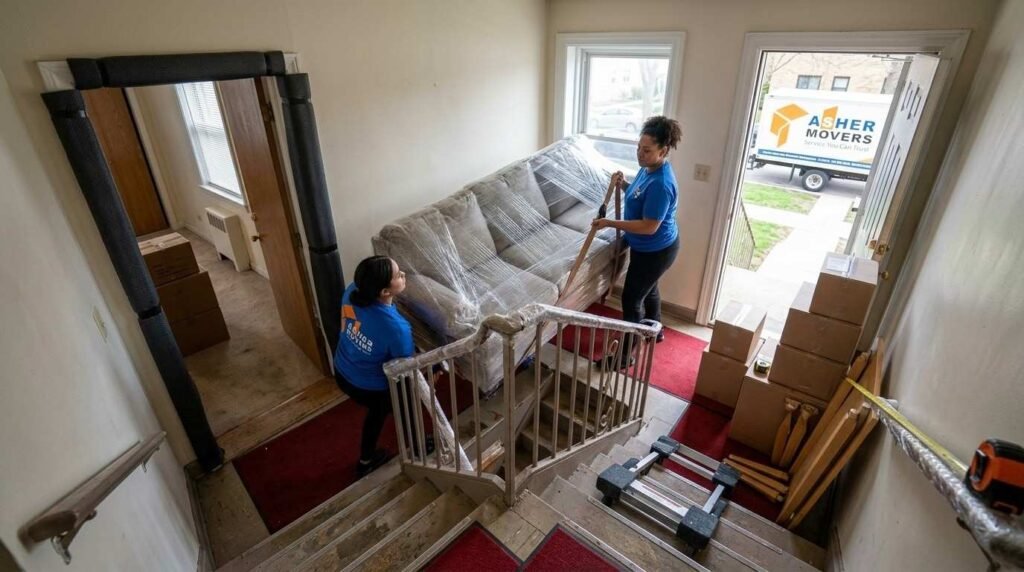
A walk-up apartment move on the third floor or higher takes longer and costs more than a ground-level move because every box, piece of furniture, and appliance has to travel by stairs instead of an elevator. Movers typically charge a long carry or stair fee once they pass the second floor, and that fee scales with how many flights the crew climbs.
I see this trip up more often than people expect, especially in older Skokie buildings without elevators. A third-floor move that looks simple on paper turns into a slow, physical job the moment the truck can’t park near the entrance.
I cover why stair carries change pricing and timing, how movers assess a walk-up before the job starts, packing habits that speed up the carry, items that slow things down, and ways to cut costs without cutting corners.
Why Walk-Up Moves on the 3rd Floor+ Cost More and Take Longer
A walk-up move costs more because labor time increases with every flight of stairs a crew has to climb while carrying weight. A move that takes two hours on the ground floor can take three to four hours from a third-floor unit, depending on stairwell width and how much furniture is involved.
Movers plan around a simple reality: stairs slow down every trip, not just the heavy ones. A dresser that takes ninety seconds to load on flat ground takes several minutes on a tight staircase with a landing turn.
How Stair Carries Change Labor Time and Pricing
Stair carry is the physical act of moving items up or down stairs instead of using an elevator or ramp. Crews often work 30% to 50% slower on stairs compared to single-level moves, since every item needs careful footing and controlled pacing.
I explain this to customers upfront because it shapes the whole estimate. More time on stairs means more labor hours, and labor hours are the biggest cost driver in almost any move.
The Point Where Buildings Usually Require a Long Carry Fee
A long carry fee applies once movers have to walk an item a set distance from the truck to the door, and stairs almost always trigger it. Most moving companies define the third floor and above as automatic long carry territory, regardless of building layout.
Skokie has a fair number of older walk-ups near the downtown corridor, and I’ve quoted plenty of them. The fee isn’t a penalty. It reflects the real physical toll of repeated stair trips carrying furniture and boxes.
How Movers Assess a Walk-Up Before Moving Day
Movers assess a walk-up by looking at stairwell width, the number of turns, ceiling height on landings, and whether the front door opens directly onto stairs. This assessment happens before the crew ever shows up, usually during the quote process.
I ask for photos or a video walkthrough whenever a move involves a third-floor unit or higher. That single step prevents most surprises on move day.
Stairwell Width, Turns, and Landing Space
Stairwell width determines whether large furniture pieces move up whole or need disassembly first. A staircase under 36 inches wide with a tight 90-degree turn often can’t fit a full-size sofa or mattress without maneuvering.
Landing space matters just as much as width. A small landing gives the crew nowhere to pause and reposition heavy items, which slows the whole carry down.
What Asher Movers Confirms During a Walk-Up Quote
Our team confirms floor number, stairwell dimensions, elevator availability, and parking distance from the entrance before finalizing a walk-up quote. We ask specifically about furniture that’s larger than a standard doorway, since that changes the labor plan entirely.
We also confirm whether the building requires a certificate of insurance or has a reserved elevator window for move-ins. Buildings that manage multiple move-outs a month tend to have these rules ready.
Packing and Prep Tips That Make Stair Carries Faster
Packing smart for a stair carry means keeping boxes lighter and more balanced than you would for a ground-floor move. Boxes over 50 pounds become genuinely difficult to control on a staircase, even for an experienced two-person team.
I tell clients to think about weight distribution first and box count second. Ten medium boxes move faster up three flights than five overstuffed ones that need constant repositioning.
Boxing Strategy for Narrow Stairwells
Boxing for narrow stairwells works best when books, dishware, and other dense items go into small or medium boxes instead of large ones. A large box full of books becomes nearly impossible to carry safely through a tight turn.
Lighter, uniformly sized boxes also stack better in a stairwell landing while a crew member repositions for the next trip. That small efficiency adds up across dozens of trips.
Furniture and Large Item Prep for Tight Turns
Large furniture needs prep work before moving day whenever a stairwell has a tight turn or low ceiling clearance. Removing legs, drawers, and doors ahead of time turns an awkward piece into something that clears the turn cleanly.
I always recommend measuring the tightest point in the stairwell against your largest furniture piece first. That one measurement tells you whether disassembly is optional or mandatory.
Items That Slow Down or Complicate a Walk-Up Move
Certain items slow down a walk-up move regardless of how experienced the crew is, mostly due to size, shape, or handling restrictions. Oversized furniture, appliances, and anything classified as non-allowable each create a different kind of delay.
Sorting these out before the truck arrives keeps the whole job on schedule. I walk through both categories with clients during the pre-move consultation.
Oversized Furniture and Awkward-Shaped Pieces
Oversized furniture includes sectionals, armoires, and large mattresses that don’t clear standard stairwell widths without careful angling. A king-size mattress alone can add 15 to 20 minutes to a single trip on a narrow, turning staircase.
Awkward shapes cause more trouble than pure weight in most walk-up situations. A round dining table or an oddly angled bookshelf takes longer to maneuver than a heavier, more uniform piece.
Non-Allowable and Restricted Items to Sort Out First
Non-allowable items are goods movers legally cannot transport, including propane tanks, flammable liquids, and certain aerosols regulated under federal hazardous materials rules. Sorting these out before packing day avoids a last-minute scramble when the crew flags something on the truck.
I always ask clients to separate these items early, especially in a walk-up where extra trips up and down are the last thing anyone wants. A clear “do not pack” pile saves real time on moving day.
How to Reduce Walk-Up Moving Costs Without Cutting Corners
Reducing walk-up costs starts with scheduling decisions rather than skipping steps that keep your belongings safe. Booking during off-peak times and confirming crew size in advance both make a measurable difference.
I steer clients toward smart planning instead of shortcuts that create risk. A move that’s scheduled well tends to cost less than one rushed together at the last minute.
Timing, Scheduling, and Crew Size Decisions
Weekday moves generally cost less than weekend moves, and mid-month dates tend to have more availability than the last week of the month. Requesting the right crew size for a walk-up also matters, since an undersized crew works slower and racks up more billable hours.
I recommend booking two to three weeks ahead for a third-floor-plus move whenever possible. That gives us room to schedule an appropriately sized crew instead of stretching a smaller one thin.
When Professional Movers Are Worth the Stair Fee
Professional movers earn the stair fee back through speed, proper equipment, and lower risk of damage during repeated stair trips. Dollies, moving straps, and door protection all reduce the chance of a costly accident on a tight staircase.
We build our Skokie walk-up jobs around this exact math. A trained crew with the right gear finishes faster and safer than a DIY crew improvising on the same stairs.
Conclusion
Walk-up moves above the second floor bring real cost and timing factors tied directly to stairwell width, item size, and crew planning. Understanding these factors early keeps moving day predictable instead of stressful.
Packing smart and sorting non-allowable items ahead of time makes the biggest difference in how smoothly a stair carry goes. Preparation beats improvisation on every third-floor job I’ve worked.
We handle walk-up moves across Skokie every week and know exactly how to plan around tight stairwells and tricky turns. Contact Asher Movers Local & Long Distance today for a walk-up quote built around your actual building.
Frequently Asked Questions
Do movers charge extra for a third-floor walk-up?
Yes, most movers charge a long carry or stair fee starting at the third floor. The fee reflects the added labor time required to carry items up multiple flights of stairs.
How long does a third-floor walk-up move take?
A third-floor move typically takes 30% to 50% longer than a ground-floor move of the same size. Stairwell width, turns, and furniture size all affect the final time.
Can movers take a couch up a narrow staircase?
Movers can usually get a couch up a narrow staircase by angling it carefully or removing the legs first. Some stairwells require partial disassembly if the turn is especially tight.
What items are movers not allowed to transport?
Movers cannot transport hazardous materials like propane tanks, flammable liquids, and certain aerosols under federal regulations. Sorting these out before packing day prevents delays on moving day.
Should I hire extra movers for a walk-up apartment?
A larger crew often costs less overall for a walk-up move because the job finishes faster with more hands on the stairs. An undersized crew tends to run up more billable hours over a longer job.
Does furniture need to be disassembled for a walk-up move?
Furniture needs disassembly whenever it doesn’t clear the stairwell’s width or turn radius fully assembled. Measuring the tightest point in the staircase ahead of time answers this question early.
Is it cheaper to move on a weekday for a walk-up apartment?
Weekday moves are generally cheaper than weekend moves, and this holds true for walk-up apartments as well. Off-peak scheduling also gives movers more flexibility to assign the right crew size.
