
I’ve coordinated enough gated community moves to know they rarely go sideways because of the movers. Gated community moves involve extra steps most standard relocations skip, including HOA approval, visitor registration, access scheduling, and amenity protection rules that vary by property. Skip one of these and moving day stalls at the gate.
Nobody plans for a move to get held up by a guard booth. I’ve watched families sit curbside for twenty minutes because nobody called ahead.
This guide walks through how gated access and HOA rules shape your move, what items movers can’t legally transport, how to prepare your belongings and schedule around gate hours, and what’s different for moves happening in Skokie, IL specifically.
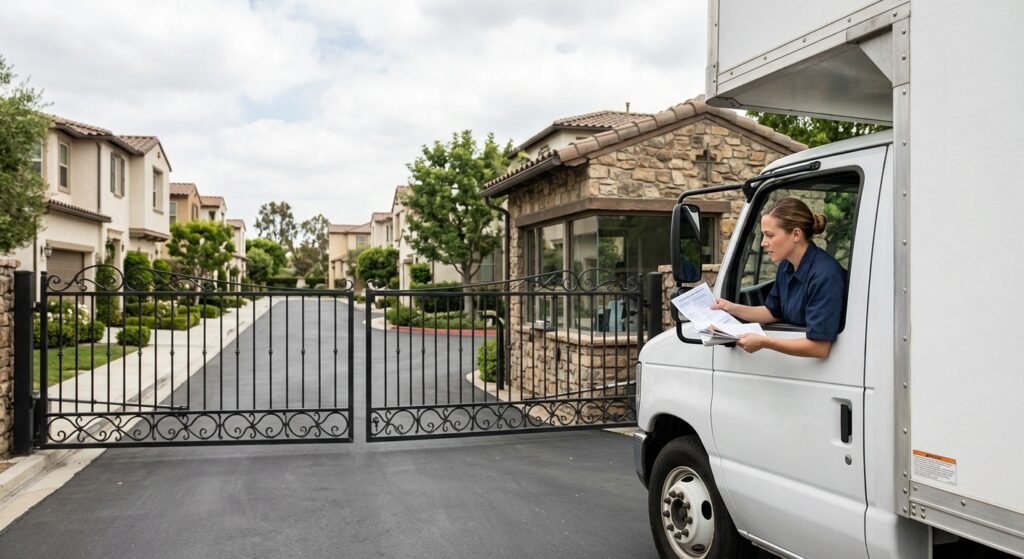
What Makes Gated Community Moves Different
Gated community moves require coordination with a third party — the property’s management or HOA — before a single box gets loaded. A standard move only involves you and the moving company. Add a gate, a guard, or an access list, and now there’s a third approval layer sitting between your move-out date and the truck actually getting through.
I’ve seen movers turned away at the gate because nobody confirmed the move was on the visitor log. That’s not a moving company failure. It’s a communication gap between the resident and the property.
Access Control Systems and Visitor Logs
Most gated properties run one of three systems: a staffed guard gate, an automated keypad/call box, or a resident-managed app that pre-approves visitors. Guard gate scheduling determines how far in advance a moving company needs its name on the list, and this differs significantly between a staffed gate and an automated one.
HOA Rules and Move-In/Move-Out Regulations
Most HOAs require written notice of a move at least 48 to 72 hours before the date, and some mandate a refundable move deposit to cover potential common-area damage. I always tell clients to pull their HOA’s move-in/move-out policy before booking anything — it’s usually a two-page PDF buried in the resident portal.
Certificate of Insurance Requirements for Movers
A certificate of insurance, or COI, is a document a moving company’s insurer issues that names the HOA or property management company as an additional insured party for the day of the move. Properties request this to confirm the moving company carries liability coverage sufficient to cover common-area damage before granting access.
Without a COI on file, some gated properties will deny entry outright, regardless of how prepared everyone else is.
Scheduling Your Move Around Gate and Guard Hours
Gated communities often restrict move activity to specific windows, commonly weekday daytime hours, to limit disruption to residents and reduce traffic through the gate during peak times. I schedule gated moves earlier in the day whenever the property allows it, since afternoon slots fill up fast during peak moving season.
Some properties close vehicle gates entirely on weekends or holidays, which catches people off guard when they’ve already booked a Saturday move.
Moving Truck Size Restrictions and Street Access
Gated communities frequently restrict the size of vehicles allowed past the entrance, and a 26-foot moving truck may simply not fit through some older gated entrances built decades before full-size trucks became standard. I ask every gated-community client to measure their gate width and clearance before booking a truck size.
Low-Clearance Gates and Turning Radius Limits
Older gated properties, especially ones built before 2000, often have low-clearance overhead gates that cap vehicle height at 10 to 12 feet, which rules out most full-size moving trucks and requires a smaller box truck or multiple trips instead.
Tight turning radii inside the community compound this — a long truck that clears the gate itself might still be unable to navigate the internal turns to reach a resident’s unit.
Parking Permits and Loading Zone Rules
Many gated communities require a temporary parking permit for any vehicle staying longer than a standard visitor window, and movers trucks typically sit on-site for two to six hours during loading. Temporary parking permits usually need to be requested through the property office at least a day in advance, separate from the general move notice given to the HOA.
Loading zones near building entrances are often reserved and ticketed if a truck occupies them without the right permit visible on the dash.
Protecting Shared Amenities During the Move
Shared hallways, elevators, lobbies, and stairwells absorb most of the wear during a gated community move, since nearly everything a resident owns passes through these common spaces at least once. Properties know this, which is why so many require padding, floor protection, or a designated move-in route before granting access.
I’ve seen HOAs charge move deposits specifically because unprotected corners and elevator walls get scuffed during even a careful move.
Elevator Reservations in Gated Condo Communities
An elevator reservation is a scheduled time block that gives a resident’s moving crew exclusive or priority use of a building elevator, preventing other residents from being delayed by furniture loads. Elevator reservation windows typically run two to four hours and often require a refundable deposit held until the property confirms no damage occurred.
Buildings with only one freight elevator book these slots weeks in advance during peak moving months, so this isn’t something to leave until the week of the move.
Common Hallway and Lobby Damage Liability
Damage to a shared hallway or lobby during a move typically falls on the resident who hired the movers, not the moving company directly, unless the mover’s insurance specifically covers third-party property damage. This is exactly what a COI protects against, and why properties ask for one before allowing trucks past the gate.
Registering Movers as Approved Vendors
Vendor registration is the process by which a gated property adds a moving company’s name, crew size, vehicle plate, and scheduled date to its approved access list ahead of time. Properties that skip this step for visitors but require it for vendors are drawing a distinction between a one-time guest and a commercial operation entering repeatedly throughout a single day.
I register the crew the moment a move date is confirmed, because some properties take 24 to 48 hours just to process the vendor paperwork.
Items Movers Cannot Transport
Professional movers are legally and contractually prohibited from transporting hazardous materials, perishable food, live plants, and certain high-value items without special arrangement. This isn’t a company preference — it traces back to Department of Transportation hazardous materials regulations that govern what can legally travel on a moving truck.
Hazardous Materials and Flammable Liquids
Hazardous materials include propane tanks, gasoline, paint thinner, aerosol cans, pool chemicals, and fireworks — anything flammable, corrosive, or pressurized enough to pose a transport risk. I ask clients to dispose of these separately or transport them personally, since a mover genuinely cannot load them regardless of how the request is phrased.
Perishables, Plants, and Live Animals
Perishable food, frozen goods, and live plants typically don’t survive a multi-hour truck ride without climate control, and most movers won’t accept liability for spoilage or die-off. Live animals fall into the same no-transport category for both welfare and liability reasons.
Preparing Your Belongings for a Gated Community Move
Packing for a gated community move follows the same core principles as any move, with one addition: boxes and furniture sometimes get a visual check at the gate if the property runs a strict security policy. I tell clients to keep an inventory sheet handy, since a guard occasionally asks what’s inside a loaded truck before waving it through.
Labeling Boxes for Gate Inspection Checks
Clear labeling speeds up any gate-level visual check considerably, since a guard glancing at “Kitchen — Fragile” moves faster than one staring at an unmarked box wondering whether to flag it. Room-by-room labeling systems also help the crew unload directly into the right rooms once inside, cutting total move time.
Security Verification and ID Requirements for Movers
Most gated properties require every crew member to present government-issued photo ID at the gate, matched against the name list submitted during vendor registration. I always confirm with the client that the names on file match exactly who’s showing up that day, since a last-minute crew swap can stall entry for everyone behind that truck.
Some properties go a step further and photograph IDs or log badge numbers for their own compliance records.
Avoiding Delays on Moving Day
Most gated-community moving delays trace back to a missing document rather than a traffic problem: no vendor registration on file, no COI submitted, or a guard who wasn’t told to expect a truck. I build in a 30-minute buffer for every gated move specifically because gate check-in rarely happens on the first try.
Calling the property office the morning of the move to confirm everything is logged correctly catches most problems before they cost anyone time.
Liability, Insurance, and Damage Claims
Liability for gated-community move damage typically splits between the resident’s homeowner or renter’s insurance and the mover’s liability coverage, depending on where and how the damage occurred. Damage inside the unit usually falls under the mover’s standard valuation coverage, while common-area damage often routes through the COI filed with the property.
| Damage Location | Typically Covered By | Claim Filed With |
| Inside the resident’s unit | Mover’s valuation coverage | Moving company |
| Hallways, elevators, lobbies | Mover’s liability policy (via COI) | Property management |
| Gate or entrance structure | Mover’s liability policy | HOA or property management |
| Resident’s own belongings | Mover’s valuation or resident’s insurance | Moving company |
Reading the valuation coverage section of a moving contract before signing clears up most confusion about what’s actually covered.
Cost Factors Specific to Gated Community Moves
Gated community moves sometimes cost more than standard local moves, driven by extended loading windows, elevator reservation fees, HOA move deposits, and occasional permit costs the property charges directly. None of these come from the moving company’s base rate — they’re property-imposed fees layered on top.
I always break these out separately on an estimate so clients aren’t surprised by a line item that technically isn’t part of the moving bill at all.
Communicating With Your HOA Before Move Day
Most of the friction in a gated-community move disappears the moment someone actually calls the HOA office directly instead of relying on the resident portal alone. I recommend confirming four things on that call: the move notice deadline, COI requirements, permitted move hours, and whether a deposit is required.
Getting these answers in writing, even a quick confirmation email, avoids disputes if a guard’s information doesn’t match what the office told the resident.
Gated Community Moving Considerations in Skokie, IL
Skokie’s gated and HOA-managed communities tend to enforce move notice windows more strictly than non-gated neighborhoods in the same area, largely due to the density of condo and townhome developments along the village’s northern corridor. Winter moves add another layer here, since several properties restrict loading dock or elevator access during icy conditions to limit liability.
Local street parking restrictions near several Skokie gated developments also affect where a truck can stage before entering, which is worth confirming with the property ahead of a scheduled date.
Choosing a Mover Experienced With Gated Communities
Experience with gated-community logistics shows up in small details: a crew that already knows to bring the COI without being asked, or one that calls the gate ahead of arrival instead of showing up unannounced. I look for movers who ask about HOA requirements during the initial quote call, since that question alone usually signals they’ve done this before.
A mover unfamiliar with gated access tends to find out about restrictions at the gate itself, which is the most expensive possible moment to learn them.
Conclusion
Gated community moves add HOA approval, vendor registration, and access scheduling on top of standard moving logistics. Understanding prohibited items, insurance requirements, and amenity protection rules keeps moving day predictable instead of stressful.
We’ve coordinated enough of these moves to know preparation beats improvisation every time gates and guards are involved.
Reach out to ASHER MOVERS LOCAL & LONG DISTANCE and we’ll handle the HOA paperwork, scheduling, and access coordination for you.
Frequently Asked Questions
Do gated communities require movers to show ID?
Yes, most gated properties require every crew member to show government-issued photo ID at the gate. This gets matched against the vendor registration list submitted before the move date.
Can movers access a gated community without prior HOA approval?
No, most gated properties deny truck access without advance HOA or management approval. Vendor registration and move notice are typically required 48 to 72 hours ahead.
What items are moving companies not allowed to transport?
Movers cannot transport hazardous materials, flammable liquids, perishable food, live plants, or live animals. These restrictions come from federal transport regulations, not company policy.
Do I need a certificate of insurance for my moving company?
Yes, many gated properties require a certificate of insurance naming the HOA as additionally insured. Without it, some properties deny gate access entirely.
How far in advance should I notify my HOA about a move?
Most HOAs require 48 to 72 hours of written notice before a move date. Some properties request a week or more for larger buildings.
Are elevator reservations required for condo moves?
Many gated condo buildings require an elevator reservation to guarantee crew access. These slots often need booking weeks ahead during peak moving months.
What happens if a moving truck is too large for the gate?
The move may require a smaller truck, multiple trips, or temporary curbside transfer. Measuring gate height and turning radius beforehand prevents this problem.
