
Local moving in beach and coastal cities is the process of relocating a household or business within a shoreline community while accounting for humidity, sand exposure, narrow access roads, and seasonal demand swings. I’ve found that coastal moves carry a distinct set of logistical and packing requirements that inland moves simply don’t, because moisture, heat, and congested beach-town streets change how belongings need to be prepared and transported. Anyone moving within Skokie, IL or a similar coastal-adjacent market runs into these factors the moment a truck gets booked.
Getting this wrong costs real time and real money on moving day. A single missed permit or an improperly packed humidifier-sensitive item can delay an entire schedule.
This guide covers what makes coastal moves different, the packing rules and prohibited items movers won’t transport, moving-day logistics around parking and building access, liability and insurance protection, specialty item handling, and what actually drives local moving costs. We’ll walk through each piece so nothing catches you off guard.
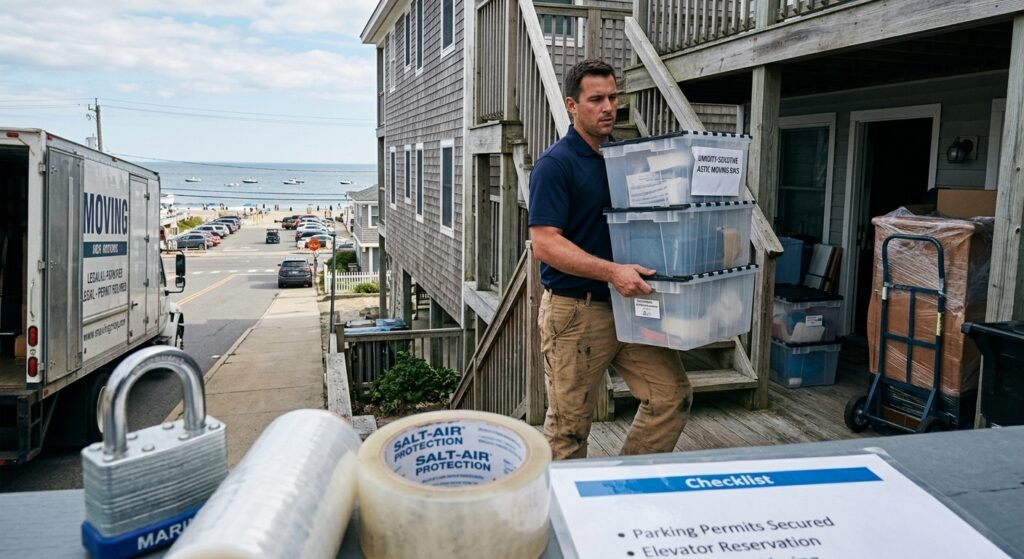
What Makes Moving in Beach/Coastal Cities Different
Coastal local moving differs from inland moving primarily because of humidity, salt air, and seasonal tourist traffic that inland movers rarely deal with. I’ve worked moves where a few hours of salt-air exposure warped wood furniture that would have been fine sitting in an inland garage for a week.
Beach cities also compress their moving seasons. Everyone wants to move in late spring or early fall, before peak tourist season locks up the roads.
Climate, Humidity & Sand Exposure Factors
Humidity is the single biggest environmental factor in coastal relocations, and it affects wood, electronics, paper goods, and fabric differently. Sand works its way into hinges, vents, and upholstery seams even when items look clean on the surface.
We treat every coastal move as a humidity-control job first and a transportation job second.
Common Challenges of Coastal Local Moves
The most common challenge in coastal local moves is restricted street access, since beach towns are often built with narrow roads that were never designed for full-size moving trucks. Add in seasonal tourist congestion, and a move that should take four hours can stretch into six or seven.
I always tell clients to check their city’s truck-size ordinances before booking, because some coastal municipalities cap vehicle length on residential streets.
Narrow Streets, Seasonal Traffic & Parking Restrictions
Parking restrictions near the shoreline are frequently tied to tourist season calendars rather than fixed dates. A street that allows unrestricted parking in January might require a permit by Memorial Day.
How Local Moving Differs From Long-Distance Coastal Moving
Local moving in coastal cities typically involves same-day transport within a 50-mile radius, while long-distance coastal moving spans multiple days and often crosses state humidity zones entirely. The practical difference shows up in packing: a local move gives belongings less total time exposed to salt air, so some moisture-protection steps that are mandatory for long-distance coastal relocation become optional for a same-day local job.
Pricing structures diverge too. Local moves are usually billed hourly, while long-distance coastal moves bill by weight and distance, which changes how movers quote humidity-related packing services. I’ve seen customers overpay for long-haul-grade moisture protection on a move that took three hours door to door.
Timing also matters more for long-distance coastal relocation, since a truck sitting in transit for two or three days gives humidity far more opportunity to cause damage than a same-day local move ever would. That timing gap is exactly why packing requirements for coastal humidity and moisture scale up the longer a shipment sits exposed.
Items Movers Cannot Transport
Movers cannot legally transport hazardous materials, flammable liquids, corrosive chemicals, and certain pressurized containers under standard interstate and intrastate moving regulations. This list typically includes items like propane tanks, paint thinners, pool chemicals, fireworks, and car batteries. I walk every client through this list before move day because finding a prohibited item mid-load causes real delays.
Coastal households carry a few prohibited-item risks that inland households don’t think about as often. Boat fuel, outdoor grill propane, and pool maintenance chemicals are common in beach communities and all fall under restricted transport categories.
A Federal Motor Carrier Safety Administration review of household goods regulations confirms that hazardous material restrictions apply uniformly across residential movers regardless of move distance.
Hazardous, Flammable & Restricted Materials
| Category | Examples | Why It’s Restricted |
| Flammable liquids | Gasoline, propane, lighter fluid | Fire risk in enclosed truck |
| Corrosives | Pool chemicals, bleach, acids | Chemical burns, container leaks |
| Pressurized containers | Aerosol cans, oxygen tanks | Explosion risk under heat/pressure |
| Perishables | Frozen food, produce | Spoilage, pest risk |
| Valuables | Cash, jewelry, important documents | Liability limits don’t cover these |
This table shows the five restricted categories movers consistently decline to transport, regardless of move distance or city.
Packing Requirements for Coastal Humidity & Moisture
Packing for coastal humidity requires moisture-resistant materials, sealed plastic containers, and desiccant packs rather than standard cardboard boxes. Cardboard absorbs ambient moisture in beach-city air, which weakens box integrity during transport and storage.
I recommend plastic bins over cardboard for any coastal move happening between May and September, when humidity peaks in most shoreline markets.
Preparing Fragile and Water-Sensitive Items
Fragile and water-sensitive items need individual moisture barriers, not just bubble wrap, when moving through a coastal climate. Standard packing paper doesn’t stop humidity from reaching wood grain or electronic components the way a sealed moisture barrier bag does.
I always double-wrap anything with exposed wood or metal components for coastal moves, since salt air accelerates corrosion faster than people expect.
Electronics, Artwork & Musical Instruments
Electronics are among the most humidity-sensitive items in any coastal move, since condensation inside a sealed device can cause internal corrosion long after the move is finished. Artwork and musical instruments made of wood face similar swelling and warping risks.
Scheduling Around Weather, Tides & Seasonal Demand
Local moves in coastal cities should be scheduled around low-tide hours and off-peak tourist months whenever a move involves beachfront or marina-adjacent properties. Tidal flooding can block access roads near the water during high tide in certain shoreline neighborhoods.
Demand also spikes hard every summer. Booking six to eight weeks ahead of a peak-season move gives far more scheduling flexibility than booking two weeks out.
Parking, Permits & Building Access Considerations
Most coastal cities require a temporary parking permit for moving trucks on residential streets, especially during tourist season. These permits typically need to be requested from the local public works or parking authority department three to five business days before the move.
I’ve had moves delayed an hour simply because nobody called ahead for a permit on a beach-town street with metered parking.
Elevator Buildings, HOAs & High-Rise Coastal Condo Moves
High-rise coastal condo moves typically require advance elevator reservations and HOA move-in/move-out approval forms submitted at least a week ahead of time. Beachfront buildings are especially strict about these windows because they manage heavy seasonal turnover.
HOA rules in coastal buildings often restrict move times to weekday mornings to avoid disrupting guests during peak vacation rental season.
Liability Coverage for Coastal Local Moves
Liability coverage for local moves is typically governed by released value protection, which compensates at a rate of 60 cents per pound per item unless full-value protection is purchased separately. This federal minimum applies to local and long-distance moves alike, but coastal moves carry additional liability considerations tied to humidity damage, which released value protection often doesn’t fully address.
Full-value protection matters more in coastal markets because moisture damage to furniture or electronics can be harder to prove was pre-existing versus move-related. I recommend documenting item conditions with photos before any coastal move begins, regardless of which coverage level gets chosen.
According to the Federal Motor Carrier Safety Administration’s consumer protection guidance, movers are required to offer both coverage options in writing before a move begins, and failing to do so is a documented consumer complaint category.
Avoiding Moving-Day Delays and Complications
The most common cause of moving-day delays in coastal cities is discovering prohibited items during loading, which forces a mid-move reorganization. The second most common cause is parking or permit issues that weren’t resolved before the truck arrived.
I always suggest a pre-move walkthrough two days ahead, specifically checking for anything on the restricted items list and confirming permit status.
Insurance Options for Valuable or Sensitive Belongings
Third-party moving insurance offers broader protection than a mover’s built-in liability coverage, particularly for high-value items like jewelry, art, or electronics. These policies are purchased separately from a moving company and typically cover full replacement cost rather than a per-pound liability rate.
Coastal homeowners with boats, outdoor furniture, or marine equipment often need a supplemental rider, since standard moving insurance policies frequently exclude watercraft and fuel-powered equipment entirely.
Moving Specialty Coastal Items (Boats, Grills, Outdoor Furniture)
Specialty coastal items like small boats, outdoor grills, and patio furniture require separate transport arrangements because standard moving trucks aren’t equipped or insured for fuel tanks and oversized marine equipment. Grills need their propane tanks removed and transported separately, often by the homeowner rather than the moving crew.
Outdoor furniture exposed to years of salt air sometimes has hidden corrosion in metal joints, which I always flag during the pre-move walkthrough so nothing collapses mid-transport.
Residential vs. Commercial Local Moving Considerations
Commercial local moves in coastal cities involve additional scheduling constraints tied to business hours, loading dock access, and equipment weight limits that residential moves don’t face. Beachfront retail and restaurant spaces often have narrow service entrances built for foot traffic, not freight.
Residential coastal moves, by comparison, center more on humidity protection and household item prep, while commercial moves center on minimizing operational downtime and protecting specialized equipment.
What factors actually drive the cost difference between these move types comes down to time, access complexity, and equipment handling.
What Influences Local Moving Costs in Coastal Cities
Local moving costs in coastal cities are primarily driven by hourly labor rates, truck access difficulty, and seasonal demand pricing that peaks between June and August. A move requiring a long carry distance from a truck to a beachfront property, due to parking restrictions, adds labor hours that directly increase the final bill.
A 2024 moving industry cost analysis by Move.org found that local moves average $1,250 to $2,100 depending on home size and labor hours, with coastal and high-demand metro markets often landing at the upper end of that range.
Humidity-protection packing materials, specialty item handling for boats or grills, and permit fees for street parking all add incremental costs that inland moves typically avoid entirely.
How to Choose a Local Mover for a Coastal Relocation
The right local mover for a coastal relocation carries specific experience with humidity-sensitive packing, parking permit coordination, and HOA move-in requirements common to beach communities. Asking a moving company directly how many coastal moves they’ve completed in the past year is a fast way to gauge real experience versus general moving competence.
I’d also confirm they carry both released value and full-value protection options, since that’s a federal requirement, and ask how they specifically handle humidity protection for wood and electronics.
Conclusion
Coastal moving involves humidity control, prohibited-item awareness, and permit coordination that inland moves rarely demand. Understanding liability coverage, specialty item handling, and seasonal scheduling keeps a shoreline relocation on track. We built ASHER MOVERS LOCAL & LONG DISTANCE to handle exactly these coastal complexities, so reach out and let’s plan your move properly.
Frequently Asked Questions
What items are movers not allowed to pack?
Movers cannot legally pack hazardous materials like propane, gasoline, pool chemicals, and aerosol cans. Perishable food and valuables like cash or jewelry are also typically excluded from standard moving contracts.
How far in advance should I book a local coastal move?
Booking six to eight weeks ahead is recommended for coastal moves, especially during peak summer season. Early booking also allows time to secure parking permits before moving day.
Do coastal moves cost more than inland moves?
Coastal moves often cost more due to seasonal demand, parking permit fees, and humidity-protection packing materials. Access difficulty near beachfront properties also adds labor hours to the final bill.
How should I prepare electronics for humidity during a move?
Electronics need sealed moisture barrier bags rather than standard bubble wrap for humid coastal climates. Letting devices reach room temperature before unpacking also helps prevent internal condensation.
What happens if my building has no elevator or loading dock?
Movers typically charge additional labor fees for stair carries or long-distance hand carries from the truck. Scheduling this in advance with your mover avoids day-of surprises and delays.
Is moving insurance required for a local move?
Released value protection is federally required and included at no extra cost, though it only covers 60 cents per pound per item. Full-value protection or third-party insurance is optional but recommended for valuable belongings.
Can movers transport propane tanks or grills?
Propane tanks cannot be transported by movers under hazardous materials regulations. The grill itself can typically be moved once the tank is removed and transported separately by the homeowner.
