
Moving trucks need roughly 75 feet of clear curb space and a legal place to park within a reasonable carry distance of your door, and in Skokie that space isn’t always guaranteed without some planning. Parking restrictions, narrow streets, and building rules can turn a straightforward move into a logistical puzzle. I’ve watched moving days go sideways over something as small as a missed street-cleaning sign.
Getting this wrong costs time, money, and patience on a day that’s stressful enough already. We put this guide together to walk you through exactly what affects truck access.
This guide covers what truck access actually means on moving day, how parking conditions affect your cost and timeline, the local rules specific to Skokie streets and buildings, and what to do before moving day to avoid surprises.
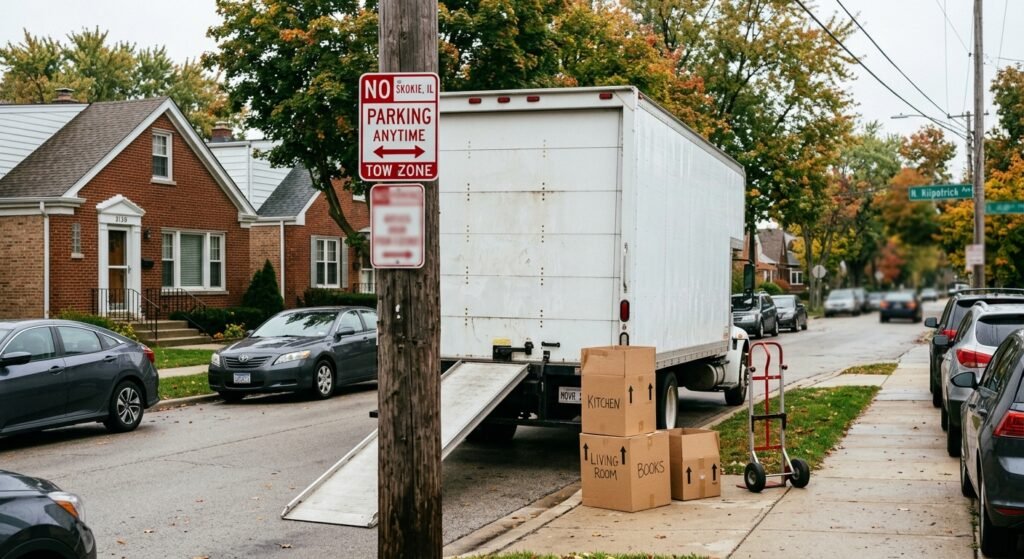
What Counts as “Truck Access” on Moving Day
Truck access means the moving truck can legally and physically park close enough to your entrance to load or unload without extra equipment. This includes legal parking availability, physical clearance for the vehicle’s size, and a reasonably short carry distance from the truck to the door.
I think about access in three layers: can the truck legally stop there, can it physically fit there, and how far will crew members have to carry your boxes. Each layer affects the next.
Truck Size and Clearance Basics
A standard moving truck runs 20 to 26 feet long and needs overhead clearance of at least 13 feet for low branches, wires, and awnings. Narrow residential streets in older Skokie neighborhoods sometimes force a smaller box truck instead of a full tractor-trailer.
Why Parking Access Affects Your Moving Cost and Timeline
Poor parking access adds time and labor to your move, and that time often shows up as an additional charge on your final bill. When a truck can’t park near the entrance, crews either shuttle items in a smaller vehicle or carry boxes a longer distance on foot, both of which slow the job down.
I’ve seen long-carry situations double the loading time compared to a straightforward driveway setup. Every extra 75 feet of carry distance beyond the standard allowance typically triggers additional labor minutes billed at your hourly rate.
Long-Carry and Shuttle Fees Explained
Most moving companies define a “long carry” as any distance beyond 75 feet from the truck to the entrance, billed in blocks of extra time. A shuttle fee applies separately when a smaller vehicle has to relay items from a distant parking spot to the main truck.
Skokie Street Parking Rules Movers Must Work Around
Skokie enforces residential permit parking zones in several neighborhoods, and a moving truck without proper clearance can be ticketed or asked to relocate mid-move. These zones typically restrict non-permit vehicles during set daytime hours on weekdays.
Street cleaning schedules add another layer, since posted signs override general parking assumptions even on otherwise open blocks. I always tell customers to physically check the signage on their block within 48 hours of the move, not rely on memory from months ago.
Residential Permit Parking Zones
Permit parking zones require any vehicle without a valid district sticker to move within a set window, often 8 a.m. to 6 p.m. A moving truck sitting in one of these zones without authorization risks a ticket or a tow mid-job.
Street Cleaning and Posted Restrictions
Posted street cleaning signs apply on fixed days regardless of permit status, and they’re enforced even if your own vehicle usually parks there freely. Checking the exact posted hours before your move date prevents a last-minute scramble to find alternate space.
How to Reserve a Moving Permit or Loading Zone in Skokie
Reserving a temporary loading zone means contacting the village’s public works or parking division ahead of your move date to request a reserved curb space. This typically involves submitting your move date, address, and expected truck size for approval.
Most villages process these requests within a few business days, so submitting early gives you a buffer against delays. I recommend treating this step the same way you’d treat booking your movers themselves, meaning it belongs on your calendar weeks out, not the night before.
Apartment, Condo, and HOA Building Access Requirements
Apartment and condo buildings often require advance notice before a move, along with a reserved freight elevator slot and a certificate of insurance from your moving company. Building management uses these requirements to protect shared hallways, elevators, and loading areas from damage.
HOA communities add their own layer, sometimes restricting move hours to weekdays only or requiring a refundable damage deposit. I always ask new customers to check their lease or HOA handbook for a “move-in/move-out policy” section, since most buildings have one even if it’s never been mentioned to them directly.
Certificate of Insurance (COI) Requests
A certificate of insurance is a document your moving company provides to building management proving active liability and workers’ compensation coverage. Buildings typically request this at least 48 to 72 hours before the scheduled move date to allow time for their review.
Single-Family Home Driveway and Curb Access Considerations
Driveway width, slope, and overhead clearance all determine whether a full-size truck can pull directly onto your property or needs to park at the curb instead. Overhanging tree branches and low power lines are the most common reasons a truck backs out and parks on the street instead.
I’ve had crews walk a driveway beforehand specifically to flag a branch that would’ve clipped the truck’s roof. A five-minute check like that avoids a much bigger problem on moving day itself.
When Movers Need a Shuttle or Smaller Truck
A shuttle becomes necessary when the main truck physically cannot reach the property due to narrow streets, weight-restricted bridges, or a height-restricted parking structure. In these cases, crews transfer belongings into a smaller vehicle capable of reaching the final delivery point.
Weight restrictions on certain older residential streets are the most common trigger I see in older Skokie neighborhoods near the Chicago border. Knowing your street’s posted weight limit in advance helps your moving company plan the right vehicle from the start.
Commercial Building and Loading Dock Access for Office Moves
Commercial office moves usually require a scheduled loading dock reservation through building management, since docks serve multiple tenants on a shared schedule. Freight elevators in office towers often need a separate booking window, sometimes limited to evenings or weekends to avoid disrupting business hours.
Business owners planning a relocation should confirm dock availability at least a week ahead, since popular buildings book out quickly around month-end, when most commercial leases turn over.
Winter and Weather-Related Access Challenges in Skokie
Snow and ice change parking availability overnight, since temporary winter parking bans and snow route restrictions can close off blocks that are normally open. Skokie enforces seasonal overnight parking restrictions during snow events, which can affect where a truck is legally allowed to sit overnight before an early move.
I plan winter moves with a backup parking option in mind, because a single snowfall can eliminate the spot you scouted the week before.
How to Prepare Your Parking Situation Before Moving Day
Confirming your parking plan 48 to 72 hours before moving day gives you enough time to secure permits, notify neighbors, or arrange an alternate space if needed. A quick walk-through of your street, driveway, and building entrance catches problems while there’s still time to fix them.
Notifying Neighbors and Reserving Space
Placing cones or a simple written notice on the curb the night before signals your intent to reserve space without requiring formal permission in most residential areas. Notifying a neighbor directly, especially one who parks in front of your home regularly, prevents an awkward conversation on moving morning itself.
What Happens If a Moving Truck Can’t Park Close Enough
When a truck can’t park within reasonable carry distance, your moving crew will either shuttle belongings in a smaller vehicle or carry items a longer distance on foot, both of which extend your total moving time. This situation usually results in additional labor charges calculated by the extra distance or the added shuttle trip.
Planning your parking space in advance is the single most effective way to avoid this scenario altogether, since most access problems are preventable rather than unavoidable.
Questions to Ask Your Moving Company About Access and Parking
Asking your moving company directly about their access policies before the move date prevents cost surprises and scheduling confusion later. Confirm whether they charge long-carry or shuttle fees, whether they require a COI for your building, and whether they’ll assist with permit paperwork if your street requires one.
How Parking Access Fits Into Your Overall Moving Checklist
Parking and truck access should be confirmed during the same week you finalize your moving date, not left until the final days before. Treating this step as part of your core checklist, alongside packing and utility transfers, keeps your moving day predictable instead of reactive.
Conclusion
Parking and truck access shape your moving day far more than most people expect, from permit zones to driveway clearance. Skokie’s seasonal rules, building requirements, and street restrictions all play a part in a smooth relocation.
We’ve covered what affects access and how to prepare for it ahead of time. ASHER MOVERS LOCAL & LONG DISTANCE can help you plan around Skokie’s parking rules so your move stays on schedule.
Frequently Asked Questions
Do I need a permit for a moving truck in Skokie?
You need a permit when parking in a residential permit zone or reserving curb space for an extended period. Checking posted signage on your specific block confirms whether a permit applies to your move.
How much space does a moving truck need to park?
A standard moving truck needs approximately 75 feet of clear curb space to park and operate safely. Narrower spaces may require a smaller truck or a shuttle vehicle instead.
What if there’s no parking available on moving day?
Your moving company will typically shuttle belongings using a smaller vehicle if no truck parking is available nearby. This usually adds time and may increase your final moving cost.
Do movers charge extra for difficult truck access?
Yes, most movers charge long-carry or shuttle fees when the truck can’t park within a standard distance. These charges reflect the added labor time required to move your belongings further.
Can a moving truck park in a fire lane temporarily?
No, fire lanes remain off-limits to moving trucks even for short periods, regardless of how briefly they’re needed. Blocking a fire lane risks a ticket and creates a genuine safety hazard.
How early should I reserve parking for movers?
Reserving parking at least 48 to 72 hours before your move date gives enough time to secure permits or notify neighbors. Earlier is better for permit zones or busy commercial buildings.
What should apartment residents do about elevator and loading dock access?
Apartment residents should contact building management at least a few days ahead to reserve a freight elevator and confirm certificate of insurance requirements. Building policies vary, so early contact avoids last-minute scheduling conflicts.
