
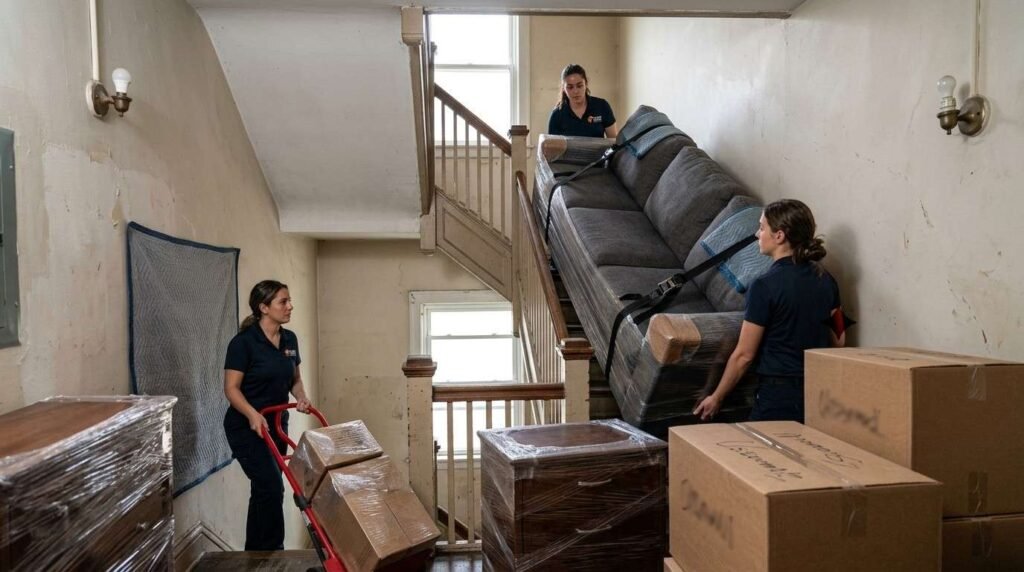
Most movers charge between $25 and $75 per flight of stairs, per mover, on top of your base moving rate. That number swings depending on how heavy your furniture is, how narrow the stairwell is, and whether the crew has to carry items more than one flight. I’ve watched this fee catch people off guard more than almost any other line item on a moving invoice.
It matters because stair carry charges are rarely explained upfront. A move that looks affordable on paper turns into a bigger bill once the crew starts hauling a dresser up three flights. Nobody wants that surprise waiting at the final invoice.
Below, I walk through what the fee actually pays for, what a flight of stairs runs in Skokie, IL, what pushes the price higher, and how to lock in a written estimate that protects you from last-minute add-ons.
What a Stair Carry Fee Actually Covers
A stair carry fee is a labor charge that compensates movers for the extra time, physical strain, and risk involved in carrying items up or down stairs instead of using a ramp or elevator. It exists because stairs slow a crew down and increase the chance of injury or damage.
I think of it less as a penalty and more as a labor recalculation. Carrying a couch up a flight takes real coordination between two or three people, and that effort has to get priced somewhere.
Why Movers Charge Separately for Stairs
Stairs change the math on a move. A crew that could load a truck in twenty minutes on flat ground might spend an hour navigating a narrow stairwell with a sectional sofa. That time gets billed.
Weight distribution matters too. Stairs force movers to lift at awkward angles, which raises injury risk and slows the pace of the whole job.
Flat Rate vs. Per-Flight Pricing Models
Some moving companies charge a flat stair fee regardless of how many flights are involved. Others charge per flight, which means the second and third floor each add their own cost on top of the first.
Per-flight pricing tends to be more transparent because you can see exactly what you’re paying for. Flat-rate pricing is simpler but can undercharge or overcharge depending on your specific building.
Average Stair Carry Costs Per Flight in Skokie, IL
Stair carry fees in Skokie generally run $25 to $75 per flight, per mover, with most local jobs landing in the $35 to $50 range for a standard residential move. A two-person crew moving a two-bedroom apartment up two flights typically adds $140 to $200 to the total bill just for stairs.
That range holds steady across most of Skokie’s older walk-up buildings near downtown and the newer multi-story apartment developments along Skokie Boulevard. Older buildings with narrower stairwells tend to land at the higher end.
How Local Movers Calculate the Per-Flight Rate
Movers typically calculate the fee based on crew size multiplied by a per-person, per-flight rate. A three-person crew carrying items up two flights at $40 per person, per flight comes out to $240 added to the base cost.
Some companies fold this into an hourly rate instead, simply slowing the clock down and letting the extra time show up as additional billed hours rather than a separate line item.
What Changes the Price Up or Down
Fewer flights and a wide, straight staircase keep costs low. A tight spiral staircase or a walk-up with a sharp turn on the landing pushes the price toward the top of the range.
Crew size also plays a role. A two-person crew moving heavy furniture up stairs works harder and slower than a four-person crew splitting the same load.
Factors That Increase Your Stair Carry Fee
Three things drive stair carry costs higher: the size and weight of your furniture, the physical condition of the stairwell, and how many flights the crew has to cover. Each factor compounds the others.
I’ve seen identical apartments generate very different stair fees purely because one had a wide, well-lit staircase and the other had a cramped turn halfway up.
Furniture Size, Weight, and Fragility
Large, heavy pieces like sectional sofas, armoires, and pianos take longer to carry and often need extra manpower or specialized equipment. Fragile items like glass tabletops or artwork require slower, more careful handling on every step.
Piano transport in particular carries some of the highest stair surcharges in the industry, since the Piano Technicians Guild notes that upright and grand pianos require specialized dollies, straps, and multi-person lifting techniques even on flat ground.
Building Type and Stairwell Conditions
Narrow stairwells, sharp turns, low ceilings, and poor lighting all slow a crew down and raise labor time. Walk-up apartments built before modern code standards often have tighter stairwells than newer construction.
Outdoor stairs exposed to weather add another variable. Wet or icy steps force movers to slow their pace considerably, which can extend billed time even on a short flight.
How to Avoid Surprise Stair Carry Charges on Moving Day
The best way to avoid a surprise stair fee is getting a written, itemized estimate before moving day that specifically states the per-flight rate and how many flights are counted. Verbal quotes leave too much room for disagreement once the truck shows up.
I always tell people to walk the mover through their space, floor by floor, during the estimate process. A rep who sees the stairwell in person gives a far more accurate number than one working off a phone description.
Questions to Ask Before Booking
Ask whether the stair fee is flat or per-flight, whether it’s billed per mover or per crew, and whether a landing that turns counts as an extra flight. Some companies count a half-flight to a landing as a full charge, and you want that clarified in writing.
Also confirm whether elevator access at either end changes the quote, since a working elevator sometimes waives the stair fee entirely.
What Belongs in a Written Moving Estimate
A solid estimate lists the base hourly or flat rate, the stair carry rate per flight, the number of flights counted at pickup and drop-off, and any long carry or shuttle fees. Every one of these should appear as its own line, not buried inside a lump sum.
Getting this in writing before moving day protects you from a crew “recounting” flights once they arrive.
Stair Carry Fees vs. Elevator and Long Carry Charges
Stair carry fees, elevator fees, and long carry fees are three separate charges that sometimes apply to the same move, and confusing them leads to billing disputes. Elevator fees typically apply when a building’s elevator is small, slow, or requires a reserved service window. Long carry fees apply when movers have to walk items a significant distance from the truck to the door, regardless of stairs.
Understanding which charges apply to your specific building keeps your final bill closer to your original quote.
When Elevator Access Still Costs Extra
A working elevator doesn’t automatically mean no extra charge. Small freight elevators that only fit one item at a time, or buildings requiring a certificate of insurance and a reserved elevator slot, often carry their own fee separate from a stair charge.
Buildings that require advance elevator booking sometimes charge movers a facility fee, which occasionally gets passed to the customer.
Comparing Total Line-Item Costs
A three-flight walk-up with no elevator typically costs more in stair fees than a building with a slow-but-functional elevator, even after accounting for the elevator’s own facility charge. Long carry fees, by contrast, apply regardless of stairs and often start once the walking distance from truck to door exceeds 75 feet, based on standard interstate tariff guidelines referenced by the Federal Motor Carrier Safety Administration.
Comparing all three line items side by side before booking gives you the clearest picture of your real moving-day total.
Conclusion
Stair carry fees reflect real labor, not padding, and understanding the per-flight rate helps you budget accurately. Furniture size, stairwell conditions, and flight count all shape your final number.
Getting a written estimate before moving day removes most of the guesswork around stairs, elevators, and long carries.
We build every quote at ASHER MOVERS LOCAL & LONG DISTANCE around a clear, itemized breakdown, so you know your stair carry costs before our crew ever lifts a box.
Frequently Asked Questions
How much do movers charge per flight of stairs?
Most movers charge $25 to $75 per flight, per mover, depending on furniture weight and stairwell conditions. Local Skokie moves typically fall between $35 and $50 per flight.
Do all moving companies charge stair carry fees?
Not all companies charge a separate stair fee; some fold the cost into a slower hourly rate instead. Always ask directly whether stairs are billed separately or absorbed into time.
Is a landing that turns counted as an extra flight?
Some companies count a landing turn as a half-flight or full flight charge, while others only count full staircases. Clarify this specific point in your written estimate before booking.
Does a working elevator remove the stair carry fee?
A working elevator often removes the stair fee, but small or slow freight elevators sometimes carry their own separate charge. Ask whether elevator access changes your total quote.
What’s the difference between a stair fee and a long carry fee?
A stair carry fee applies to vertical movement between floors, while a long carry fee applies to horizontal distance between the truck and the door. Both can apply to the same move independently.
Can I negotiate my stair carry fee?
Some movers adjust the fee if you handle smaller items yourself or reduce the number of heavy pieces going up stairs. Ask your mover directly what flexibility exists before the move date.
