
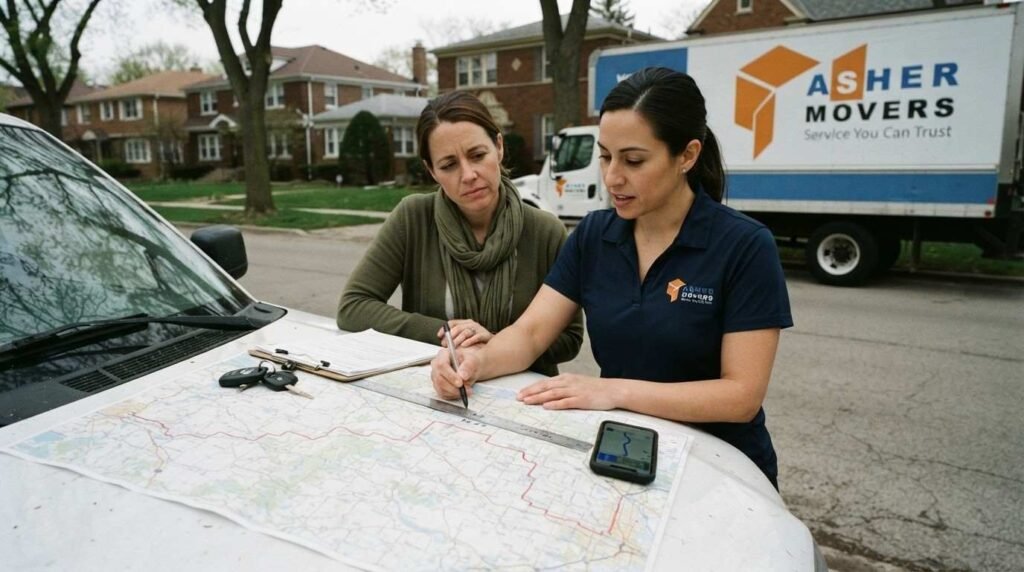
Movers calculate the 50-mile and 100-mile threshold using the driving distance between your origin address and your destination address, not a straight line on a map. That single number decides whether you get billed by the hour or by weight and distance. I have watched customers assume a 62-mile move was still “local,” then get surprised at the estimate.
The gap between those two pricing models runs into hundreds of dollars on a typical three-bedroom home. Knowing which side of the line you sit on before you call gives you real negotiating power.
Below I walk through what each threshold actually means, how crews and dispatchers measure the mileage, why crossing the line rewrites your rate structure, how Illinois rules apply in Skokie, the situations that quietly push a move over, and how to verify the number in writing before you sign.
What the 50-Mile and 100-Mile Moving Thresholds Actually Mean
A mileage threshold is a distance boundary that a moving company uses to separate local service from long-distance service. Cross it, and the whole billing method changes.
Most Illinois carriers set that boundary at 50 miles. Some national van lines use 100 miles instead. Neither number is a federal law.
The confusion comes from the fact that both numbers are real and both are in active use.
Local move vs. intrastate move vs. interstate move
A local move stays inside one metro area and under the carrier’s mileage limit. An intrastate move stays inside Illinois but travels beyond that limit. The difference between local and long distance moving comes down to that boundary plus any state line you cross.
I get calls from people in Skokie moving to Kenosha, about 55 miles away. That trip is short, but it crosses into Wisconsin, so it falls under federal interstate rules regardless of the mileage.
Why two different numbers exist in the same industry
The 50-mile mark comes from state tariff traditions and from how far a crew can drive, load, unload, and return inside one shift. The 100-mile mark comes from van line network planning, where anything under 100 miles gets handled by the local agent rather than a linehaul truck.
Ask which number your specific company uses. Two movers quoting the same job can land on opposite sides of the same trip.
How Movers Measure the Miles Between Your Two Addresses
Dispatchers do not eyeball it. They pull a mileage figure from software, and that figure becomes part of your written estimate.
Straight-line radius vs. driving distance
A straight-line radius draws a circle around the origin. Driving distance follows actual roads.
Almost every reputable carrier uses driving distance, because that is what the truck burns fuel on. The difference matters here. Skokie to Aurora is about 38 miles as the crow flies and closer to 45 by road, which can be the difference between local and long-distance under a tight 40-mile cap.
Origin ZIP to destination ZIP mapping
Many tariffs measure ZIP code to ZIP code rather than door to door. The system takes the centroid of your origin ZIP and the centroid of your destination ZIP, then returns the road distance between them.
That method smooths out small variances. It also means two neighbors on the same block get the same mileage figure.
Tariff mileage tables and rate-map software
Household goods carriers publish tariffs that include mileage tables. Software such as commercial rate-mapping tools reads those tables and returns a distance that both the mover and the regulator recognize.
The Federal Motor Carrier Safety Administration requires interstate movers to give consumers written estimates and specific disclosure documents before a move. Ask which mileage source produced your number and request it on paper.
Why the Threshold Changes How You Get Charged
This is the part that costs people money. The threshold is not a formality. It swaps one pricing formula for a completely different one.
Hourly rate structure under the threshold
Under the threshold, you pay an hourly rate covering the crew and the truck. Two movers and a truck run at one rate, three movers at another, and the clock usually starts when the crew leaves the yard.
Stairs, long carries, and slow elevators all inflate an hourly job. Understanding how local moving costs are calculated explains why a short move with a difficult building beats a longer move with easy access on price.
Weight-and-distance rate structure over the threshold
Past the threshold, the bill shifts to shipment weight multiplied by mileage, plus accessorial charges for packing, shuttles, and bulky items. Your truck gets weighed empty and loaded, and the difference is your shipment weight.
The clock stops mattering. Now the scale ticket matters.
One practical result: decluttering barely helps an hourly local move but cuts a long-distance bill directly. Every pound you leave behind comes off the rate.
State Rules That Move the Line in Illinois
Mileage thresholds do not float free. They sit inside a regulatory framework, and Illinois has its own.
Intrastate authority and the Illinois Commerce Commission
Moves that begin and end inside Illinois fall under state jurisdiction. The Illinois Commerce Commission licenses household goods movers operating within the state and publishes consumer guidance on rights and complaints.
Verify licensing before you compare mileage numbers. An unlicensed operator can quote you anything, and you have no regulator to call when the number changes on moving day.
Crossing into Wisconsin or Indiana from Skokie
Skokie sits roughly 45 miles from the Wisconsin border and about 35 miles from Indiana. Plenty of local-feeling moves cross a state line.
Any state-line crossing makes the move interstate. Federal rules apply, the mover needs a USDOT number, and the 50-mile question becomes irrelevant. I tell Skokie customers to name the destination city first, before we ever discuss distance.
Common Situations That Push a Move Over the Threshold
Some moves start under the line and finish over it. These are the ones that generate disputes.
Multi-stop and split-delivery moves
Picking up from a second address adds mileage. Dropping part of the shipment at a relative’s house adds more.
Carriers total the full route, not just point A to point B. A 40-mile move with two extra stops can total 70 miles of billable distance.
Storage-in-transit and re-delivery mileage
Goods that sit in a warehouse between pickup and delivery generate two trips. Under a storage in transit arrangement, the trip to the warehouse counts and the trip out to your new home counts.
Add those legs together and a tidy local job crosses into long-distance territory. Ask how storage legs get measured before you agree to a warehouse hold.
Contextual border: You now know how the number gets built. The next question is how to confirm it before you commit.
How to Verify Your Mileage Before You Book
Getting the mileage in writing protects your rate. It also tells you fast whether a company is being straight with you.
Questions to ask on the estimate call
Ask which mileage threshold the company uses, 50 or 100. Ask whether the figure comes from driving distance or a straight-line radius, and whether it runs door to door or ZIP to ZIP.
Then ask the one that matters most. What happens to my rate structure if the final mileage lands one mile over the line?
A clear answer signals a well-run dispatch office. A vague one signals a bill you cannot predict.
Documents that lock the mileage in writing
Get a written estimate showing the mileage figure, the rate structure it triggers, and the accessorial charges attached. For interstate moves, you also receive a bill of lading and an inventory sheet.
Keep every version. If the number changes between the estimate and moving day, the paperwork is your leverage.
Conclusion
The 50-mile and 100-mile thresholds decide whether your move gets billed hourly or by weight and distance. Driving distance, tariff tables, and state jurisdiction all feed that single number.
Multi-stop routes, storage legs, and state-line crossings shift the calculation more often than most people expect. Confirming the figure in writing keeps your estimate honest.
We measure every Skokie move against the real route before we quote it. Call ASHER MOVERS LOCAL & LONG DISTANCE for a written mileage-verified estimate today.
Frequently Asked Questions
Is the 50-mile moving threshold a federal law?
No. The 50-mile mark comes from carrier tariffs and state practice, not federal statute. Federal rules apply based on crossing state lines, not distance.
Do movers use driving distance or straight-line distance?
Most reputable movers use driving distance from road-mapping software. Straight-line radius shows up occasionally in service-area definitions, so confirm which method your quote uses.
Does a 30-mile move into Wisconsin count as local?
No. Any move crossing a state line is interstate under federal rules, regardless of how short the trip is.
Why did my mover quote 50 miles and another quote 100?
Companies set their own thresholds. Local carriers commonly use 50 miles, while van line agents often use 100 miles for network routing purposes.
Does extra mileage always cost more?
Not directly on hourly local moves, where time drives the bill. On weight-and-distance moves, mileage multiplies against shipment weight and raises the total.
Do additional stops count toward the mileage total?
Yes. Carriers measure the full route including every pickup and drop-off, so extra stops can push a move past the threshold.
How do I confirm my mover is licensed in Illinois?
Check the Illinois Commerce Commission listing for intrastate carriers, and verify a USDOT number for any interstate move.
