
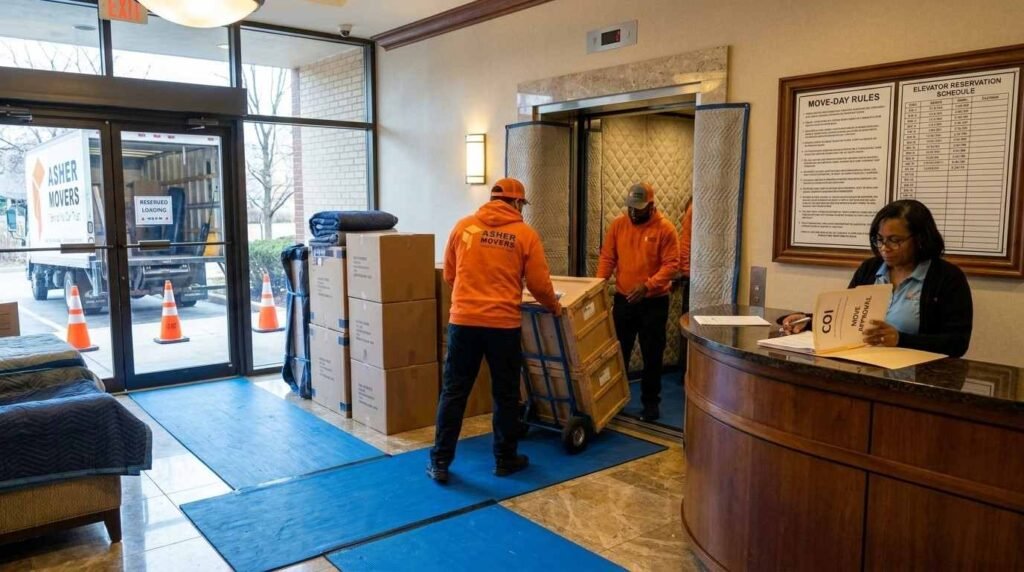
Condo local moves in Skokie almost always require a Certificate of Insurance, a booked elevator window, and a clear list of fees before your building will approve the date. I’ve walked enough clients through this exact process to know the paperwork trips people up more than the actual packing does.
Condo boards and property management companies exist to protect the building, and that means they control who moves what, when, and how. Skip a step and your move date gets pushed, sometimes the same morning your truck shows up.
I’ll walk you through why buildings require a COI, what move-in and move-out rules typically look like, which fees you should expect, how to get your COI ready in time, and how to avoid the last-minute scramble with your condo board or property manager.
Why Condo Buildings Require a Certificate of Insurance (COI)
A condo building carries real liability risk every time a moving truck pulls up. Hallway walls get scuffed, elevators get dented, lobby floors get scratched, and someone has to be financially responsible when that happens.
A Certificate of Insurance is a document a moving company’s insurer issues that names the condo building or HOA as an additional insured party for the day of the move. It protects the building against damage claims tied directly to the move.
Property managers aren’t being difficult when they ask for one. They’re following a liability protocol that most condo insurance policies actually require them to enforce.
What a COI Actually Covers
The COI typically lists general liability coverage, often in the $1 million to $2 million range, along with workers’ compensation if the moving crew carries employees rather than contractors. Buildings usually specify these minimums in their move-in packet.
It does not cover damage to your own belongings. That’s a separate conversation with your moving company about valuation coverage, and it’s worth having before move day, not during it.
Who Requests the COI (Building Manager vs HOA)
In rental-adjacent condo buildings, the property management company usually issues the requirement and reviews the document. In owner-occupied buildings, the HOA board or its appointed management firm handles it instead.
Either way, the request typically arrives with your move approval paperwork. I always tell clients to ask for the building’s exact insurance requirements the same day they book a moving date, not the week before.
Condo Move-In and Move-Out Rules You Need to Know
Every condo building has its own move-day rulebook, and most of it comes down to protecting shared spaces. Elevators, hallways, lobbies, and loading areas all get used by other residents too.
Buildings commonly restrict which entrances movers can use, require floor protection on carpeted hallways, and limit the total time a crew can occupy an elevator. None of this is arbitrary. It’s how a 40-unit building avoids ten trucks showing up on the same Saturday.
Elevator and Loading Dock Reservations
Most condo buildings require an elevator reservation booked in advance, often 48 to 72 hours ahead of the move date. Some buildings cap reservations at two or three hours per unit, which matters a lot for a larger three-bedroom move.
Loading docks work the same way where they exist. First-come scheduling isn’t how this works in a shared building — it’s booked slots, and missing your slot can mean waiting for the next opening.
Approved Moving Hours and Building Restrictions
Weekday moves often get a wider window than weekend moves, since weekends see more foot traffic and more competing reservations. Many buildings also block moves entirely on Sundays or holidays.
Some HOAs restrict moving hours to something like 9 AM to 5 PM specifically to avoid disturbing residents during early mornings or evenings. Check your building’s move-in packet before you assume standard hours apply.
Common Condo Moving Fees and What They Cover
Condo moving fees catch people off guard because they’re separate from anything your moving company charges. These go to the building or HOA directly, not to your mover.
Fee structures vary by building size and management company, but a few categories show up almost everywhere. Knowing them ahead of time keeps your moving budget from getting an unpleasant surprise.
Refundable Deposits vs Non-Refundable Fees
A refundable damage deposit, often somewhere between $200 and $500, gets returned after a post-move inspection confirms no damage occurred. This one comes back to you, assuming the hallways and elevator look the way they did before.
A non-refundable administrative or move fee, sometimes $150 to $300, covers the building’s cost of scheduling, staffing an attendant, and processing your paperwork. That one doesn’t come back regardless of how clean your move goes.
Elevator Padding and Damage Waiver Charges
Some buildings charge a separate elevator padding fee, and some require the moving company to supply and install the padding themselves as a condition of approval. Either way, this step isn’t optional in most buildings.
A damage waiver charge sometimes replaces the deposit model entirely, functioning more like an insurance premium than a refundable hold. Ask your property manager directly which model your building uses.
How to Get Your COI Prepared Before Moving Day
Getting the COI issued is usually the single fastest step in the entire process, as long as you start it early. The delay almost never comes from the insurer. It comes from waiting too long to request it.
Your moving company handles the actual document request with their insurance provider. Your job is making sure the building’s exact requirements reach the mover with enough lead time.
Information Your Building Requires From the Mover
Buildings typically need the moving company’s legal business name, coverage amounts, the building’s name listed as additional insured, and the specific move date. Get this information directly from your property manager’s move-in packet rather than guessing at a template.
Handing your mover a copy of the building’s exact requirements, rather than a verbal summary, cuts out a lot of back-and-forth. I’ve seen COI requests bounce three times over a missing policy number that could’ve been caught on the first request.
Typical Turnaround Time and Common Delays
Most insurers issue a COI within 24 to 48 hours of a complete, accurate request. The Insurance Information Institute notes that standard commercial liability documentation typically processes quickly once all required policy details are confirmed.
Delays almost always trace back to incomplete information. A missing suite number, an outdated coverage minimum, or a building name that doesn’t match the property management company’s legal entity name will all bounce the request back.
Avoiding Move-Day Delays With Condo Boards and Property Managers
Condo boards aren’t trying to make your move harder. They’re managing a shared building where one bad move-day experience becomes everyone’s problem. A little advance coordination avoids almost every delay I’ve seen.
The buildings that run move day smoothly are the ones where the resident treated the paperwork with the same seriousness as the packing.
Building a Moving Day Checklist for Condo Approval
Confirm your elevator or loading dock reservation in writing. Request the COI at least a week before your move date. Verify the building’s damage deposit and administrative fee amounts directly with the property manager, and keep a printed copy of all approvals with you on move day.
That printed copy matters more than people expect. Building staff on duty aren’t always the same person who processed your paperwork.
What Happens if the COI or Reservation Isn’t Ready
A missing COI typically means the building attendant turns your moving truck away at the door, full stop. No exceptions get made for a crew already unloading in the parking lot.
A missed elevator reservation usually means waiting for an open slot, which can push a move by hours or into the next day depending on the building’s schedule. We coordinate directly with condo property managers to confirm COI and reservation requirements before move day, so nothing gets left to guesswork.
Conclusion
Condo moves come with a layer of paperwork that standalone houses never require. The COI, the elevator reservation, and the building’s fee structure all need attention before the truck arrives.
Getting ahead of these requirements protects your move date and your deposit. A building that trusts the paperwork trusts the move itself.
We handle COI requests, elevator scheduling, and condo fee coordination for every local move we book. Reach out to ASHER MOVERS LOCAL & LONG DISTANCE and let’s get your condo move approved without the last-minute scramble.
Frequently Asked Questions
What is a Certificate of Insurance for a condo move?
A Certificate of Insurance is a document from a moving company’s insurer that names the condo building as an additional insured party. It protects the building against liability claims tied to the move.
How far in advance should I request a COI?
Request your COI at least one week before your move date. Most insurers issue the document within 24 to 48 hours once they receive complete information.
Do all condo buildings charge moving fees?
Most condo buildings charge some combination of a refundable damage deposit and a non-refundable administrative fee. Amounts vary by building, so check your move-in packet directly.
Can I move into a condo without a COI?
Most condo buildings will not approve a move without a valid COI on file. Building attendants typically turn away movers who arrive without one.
Who pays for the condo’s damage deposit?
The resident moving in or out typically pays the damage deposit directly to the building or HOA. It gets refunded after a post-move inspection finds no damage.
What happens if my elevator reservation gets missed?
Missing your elevator reservation usually means waiting for the next available slot, which can delay your move by several hours or push it to another day.
