
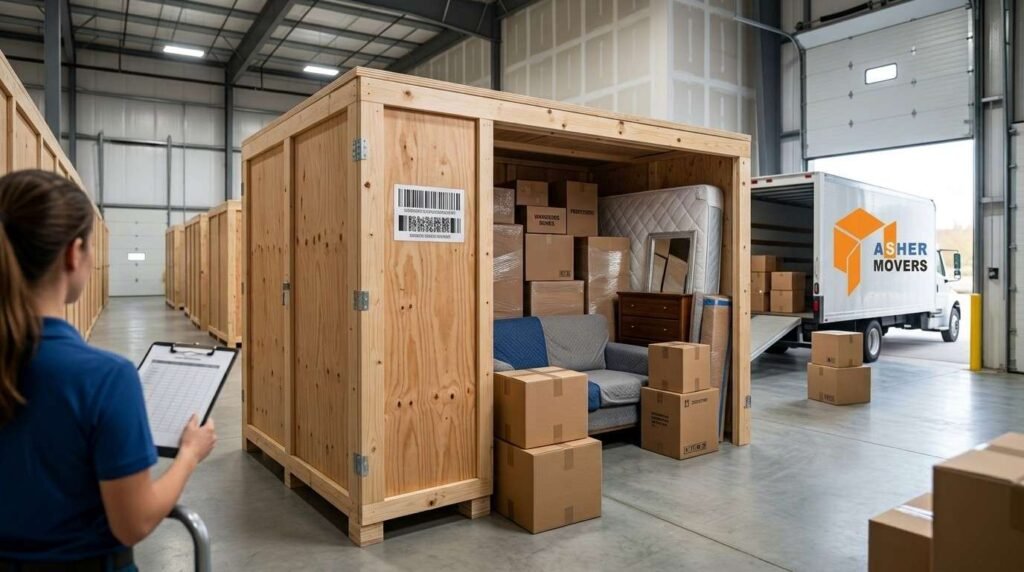
Moving storage and warehousing give you a reliable bridge between where you are and where you’re going and understanding how they work prevents costly mistakes on moving day. Whether you’re in the middle of a residential transition or relocating a full office in Skokie, IL, the rules around what gets stored, how it’s handled, and what it costs are specific and non-negotiable.
Storage gaps during a move create real stress, and the wrong choice in a provider or a missed prohibited item causes delays and unexpected fees that derail your timeline.
This guide covers everything: storage types, warehousing processes, prohibited items, packing standards, cost structures, insurance basics, and exactly what to look for in a moving storage company in Skokie, IL.
What Is Moving Storage and Why Does It Matter?
Moving storage is a temporary or extended holding service provided by professional movers or dedicated warehousing facilities to bridge the gap between your departure and destination dates. It is not the same as renting a self-storage unit on your own. When a moving company manages your storage, your items are packed, inventoried, transported, and secured under the mover’s direct supervision which comes with specific liability considerations, handling protocols, and release procedures.
It matters because timing rarely works out perfectly. Closing dates shift, leases end before new ones begin, and construction delays happen. Moving storage turns those gaps from a crisis into a manageable step.
The Difference Between Short-Term and Long-Term Storage
Short-term storage typically covers a window of one to four weeks the most common scenario being a gap between your move-out and move-in dates. Long-term storage extends beyond that, running from one month to several years, and is often used by people downsizing, relocating internationally, or staging a home for sale.
The handling and pricing differ between the two. Short-term arrangements are often bundled directly into a move, while long-term storage carries its own monthly fee structure and contract terms. Both require the same attention to packing quality and prohibited item rules.
When Storage Becomes a Necessary Part of the Move
Storage becomes essential when your new space isn’t ready at the same time your old one ends. Renters dealing with a lease gap, homeowners caught between closing dates, and families navigating a staged home sale all reach this point. It also comes up when you’re moving into a smaller space and need time to decide what stays permanently.
For businesses, storage steps in during office renovations, phased relocations, and equipment transitions where everything can’t arrive on day one. It’s a practical tool, not a last resort.
Types of Moving Storage Solutions Available in Skokie, IL
Not every storage solution works the same way, and choosing the wrong type for your situation adds cost and complication. Skokie residents and businesses have access to several distinct formats, each with a different balance of convenience, security, cost, and access.
Portable Storage Containers vs. Warehouse Vaults
Portable storage containers often associated with brands like PODS are delivered directly to your property. You load them on your own timeline, and the company picks up and transports the container when you’re ready. The convenience is real, but street access, parking restrictions, and HOA rules in Skokie can make placement complicated.
Warehouse vaults are a different format entirely. Your mover loads your items into a large wooden vault at the facility typically 5×7 feet and stackable. The vault is sealed, assigned a tracking ID, and stored inside a secured warehouse. You don’t access a vault the way you’d access a self-storage unit. It’s built for security and inventory accuracy over on-demand access.
Climate-Controlled Storage: What It Protects and When You Need It
Climate-controlled moving storage maintains a consistent temperature and humidity level inside the storage environment typically between 55°F and 85°F with controlled relative humidity. Wood furniture, musical instruments, electronics, artwork, wine, antiques, leather, and documents all benefit directly from this environment. Without it, heat and moisture cause warping, cracking, mold, and corrosion.
In Skokie, IL, where winters drop well below freezing and summer humidity climbs, climate control is not a luxury for sensitive items. It’s the correct standard.
Self-Storage vs. Mover-Managed Storage Key Differences
Self-storage means you rent a unit at a facility, you handle all transport, and you maintain direct access at all hours. The liability is entirely yours, the packing is entirely yours, and the security varies by facility. Mover-managed storage means the moving company handles transport, intake, inventory, and security under their operating license and liability structure.
The key distinction is accountability. With mover-managed storage, your belongings are documented and tracked from pickup to delivery. With self-storage, you’re managing everything independently.
How Moving Warehousing Works The Full Process
Understanding the warehouse process removes the mystery and helps you know exactly what to expect after your items leave your front door. The process follows a specific sequence designed to maintain chain of custody, prevent damage, and make retrieval efficient.
Intake, Inventorying, and Vault Assignment
When your items arrive at the warehouse, the intake process begins immediately. A moving crew supervisor walks through every item and creates a detailed inventory sheet noting each piece, its condition at the time of intake, and any pre-existing damage. You sign this document. It becomes the official record for your entire storage period.
Items are then loaded into a vault or assigned a specific storage section. The vault is sealed and labeled with your unique storage ID. Nothing goes into the warehouse without a documented condition report, and that document protects both you and the moving company.
How Your Items Are Tracked While in Warehouse Storage
Modern moving warehouses use a combination of vault ID numbers, barcode scanning, and digital manifests to track items throughout their time in storage. Each vault is tagged, and that tag number ties back to your customer account, your inventory list, and your intake condition report. Nothing moves inside the warehouse without a corresponding record update.
This matters most when something goes missing or gets damaged. The tracking record establishes exactly when an item entered, where it was stored, and what condition it was in at every stage.
The Release and Delivery Process From Warehouse to Home
When you’re ready for delivery, you contact the storage coordinator typically with a minimum of 48 to 72 hours’ notice, depending on the company’s policy. The warehouse team locates your vault, verifies the inventory against your original manifest, and schedules a delivery crew. On delivery day, your items arrive and are placed inside your new home, and you sign off on the condition of each item against the original intake record.
Any discrepancy between the intake condition report and the delivery condition is documented immediately and forms the basis for any damage claim. This is why the intake document matters so much.
What Items Can and Cannot Go Into Moving Storage
This section is one of the most important in this entire guide. Moving companies and warehousing facilities operate under strict rules about what they accept. Putting a prohibited item into storage creates liability issues, safety hazards, and in some cases triggers the termination of your entire storage contract.
Items Movers Typically Accept for Storage
The vast majority of household and commercial contents qualify for moving storage. Furniture, boxed personal belongings, appliances, electronics, clothing, books, and standard office equipment all fall into this category. Disassembled items bed frames, shelving, desks are accepted as long as hardware is bagged and taped to the corresponding piece. Artwork and mirrors require appropriate packing, typically flat packing or mirror boxes.
Vehicles, boats, and outdoor equipment like riding mowers are accepted by some facilities but require advance notice and often separate storage arrangements.
Prohibited Items What Cannot Be Stored or Transported
Moving companies and warehouses prohibit a specific category of items, and this list is non-negotiable. The core categories are hazardous materials, perishables, living things, and irreplaceable valuables.
Prohibited items include:
- Flammable liquids and gases gasoline, propane tanks, lighter fluid, paint thinner, nail polish remover
- Explosives and ammunition firearms are typically accepted if unloaded and compliant, but live ammunition is prohibited
- Corrosive chemicals acids, bleach, cleaning solvents, fertilizers
- Perishable food any item that can rot, attract pests, or create biological hazard
- Plants living plants cannot survive vault storage and create moisture and pest problems
- Medical and pharmaceutical items prescription medications, controlled substances
- Irreplaceable documents passports, birth certificates, and financial records belong with you, not in a vault
- High-value cash, jewelry, and precious metals these require a different custody chain than standard moving storage provides
The Federal Motor Carrier Safety Administration governs hazardous materials transportation rules for interstate movers, and those standards extend directly into warehousing intake procedures.
High-Value and Fragile Items: Special Handling Requirements
Antiques, fine art, sculptures, large mirrors, marble tabletops, and high-end electronics don’t move through the standard packing and loading process. They require custom crating, padded blanket wrapping, and often a dedicated handling team. Most reputable moving companies in Skokie offer specialty packing services for these items, and they carry distinct liability terms.
If you have items in this category, discuss them explicitly during your pre-move survey. Do not assume they qualify for standard storage handling.
How to Prepare Your Belongings for Moving Storage
Preparation is where most storage problems begin and end. Properly prepared items move through storage without incident. Improperly packed items create damage claims, liability disputes, and real financial loss.
Packing Standards That Apply to Stored Items
Items going into moving storage follow the same packing standards as items being transported directly to a new home and in some ways, stricter ones, because they’ll remain stationary under weight and in varying conditions for an extended period. Every box needs to be full, with appropriate padding filling any gaps, because empty space allows collapse under stacked weight. Double-walled boxes are the correct standard for heavy items like books and kitchen goods.
Furniture requires disassembly where applicable, clean surfaces (food residue attracts pests), and protective wrapping on all surfaces. Appliances need to be drained of water and cleaned. Glass surfaces on furniture need to be wrapped or removed.
Labeling, Organizing, and Inventory Best Practices
Every box needs a room label, a brief contents description, and a fragile notation where applicable. Before anything goes into the moving truck, photograph every item and every box. This photographic record is your best protection if a damage claim becomes necessary.
Create your own master inventory list independently of the mover’s intake sheet. Your list and the mover’s intake document should match. If they don’t, address the discrepancy before signing anything. Keep a digital copy of both documents in a location you can access from anywhere.
What Happens to Improperly Packed Items in Storage
Moving companies operate under a standard called “packer’s liability.” If the company’s crew packs an item and it gets damaged, the mover typically bears liability. If you pack an item yourself and it gets damaged due to inadequate packing, the mover is generally not liable even if the external box shows no signs of mishandling.
This distinction is not a technicality. It’s a real and commonly applied defense in damage claims. Packing your own items to the same professional standard that movers use is the only way to protect yourself fully.
Understanding Moving Storage Costs in Skokie, IL
Cost transparency is where the moving storage industry has the most room for improvement. Knowing exactly how fees are structured before you sign prevents the unpleasant discoveries that show up on final invoices.
How Storage Fees Are Calculated (Monthly, Vault, Delivery)
Moving warehouse storage fees are typically calculated one of two ways: by the number of vaults your belongings occupy, or by cubic footage. A standard vault runs approximately 5x7x7 feet. A one-bedroom apartment typically fills one to two vaults. A three-bedroom home might require three to five.
Monthly fees per vault vary by region, facility quality, and whether climate control is included. In the Chicago metro and Skokie area, expect a range of approximately $75 to $150 per vault per month for standard storage, with climate-controlled options running 20 to 40 percent higher. Delivery fees charged when your items are transported from the warehouse to your new home are separate from monthly storage charges and are calculated like a standard local move.
Hidden Costs to Watch For in Storage Contracts
The monthly vault fee is rarely the only cost. Watch for minimum storage period requirements some contracts require a minimum of one to three months even if you only need two weeks. Administrative or account setup fees are common. Access fees apply at facilities where you can request partial retrieval from your vault, and those fees cover the labor required to locate, unseal, and reseal your vault.
Fuel surcharges on delivery, redelivery fees for missed appointments, and late payment penalties are all standard clauses that catch customers off guard. Read every line of the storage addendum before signing the main moving contract.
How to Reduce Your Moving Storage Costs Without Cutting Corners
The most direct way to reduce storage costs is to reduce the volume going into storage. Decluttering before your move donating, selling, or discarding items you don’t need in your new space directly reduces the number of vaults required. Every vault you eliminate saves $75 to $150 per month.
Timing also matters. If you have flexibility on your delivery date, coordinating your storage release with the mover’s off-peak schedule often reduces the delivery fee. Bundling your move and storage with the same company also creates negotiating room, since many movers offer package pricing when both services are booked together.
Moving Storage for Residential vs. Commercial Moves
The mechanics of storage are the same whether you’re moving a studio apartment or a 10,000-square-foot office, but the scale, timeline, and specific requirements differ enough to address separately.
Homeowners and Renters What Storage Looks Like for You
For homeowners, moving storage most often bridges the gap between selling one property and taking possession of another. Staging a home for sale also drives storage demand sellers frequently move excess furniture into storage to make their home show better, then move it to their new address after closing.
Renters face a different version of the same problem: lease end dates and new lease start dates that don’t align, often by two weeks to a month. Short-term storage fills that window cleanly, and because renters typically have smaller volumes, the cost is proportionally lower than for larger households.
Business Owners Warehousing Solutions for Office and Commercial Relocations
Commercial moves into warehousing involve a different level of complexity. Office furniture, IT equipment, servers, filing systems, and specialty equipment all move through the same intake and inventory process as residential items, but the stakes for damage and misplacement are higher.
Businesses should confirm that their moving company offers dedicated commercial warehousing with separate inventory tracking for business assets. Chain-of-custody documentation is especially important for IT equipment and any regulated records. Phased delivery where stored items are released in batches as your new space comes online is a standard warehousing service for commercial clients and worth requesting specifically.
Insurance and Liability Protecting Your Items in Storage
Understanding your liability coverage before your items enter storage is not optional. It’s the single most important step in protecting yourself financially if something goes wrong.
What Moving Company Liability Covers in Storage
Federal regulations require all licensed interstate movers to offer two levels of liability. Released value protection is the default and covers your items at $0.60 per pound per article which means a 10-pound laptop worth $2,000 is covered for $6.00. This default coverage is included at no extra charge, but it provides almost no real protection.
Full value protection is the alternative. Under this coverage, the mover is responsible for repairing the item, replacing it with a similar item, or paying the current market value whichever is less. This coverage comes at an additional cost, but it is the only meaningful protection for anything of real value. The FMCSA consumer guide to moving details your full rights under both coverage types.
When to Purchase Additional Storage Insurance
Moving company liability even under full value protection has limitations. High-value items above a declared threshold, items packed by owner, and items with pre-existing damage are common exclusions. If your belongings include fine art, jewelry, collectibles, or high-end electronics, a standalone storage insurance rider from a third-party insurer fills the gaps that moving liability leaves open.
Check your homeowners or renters insurance policy first. Some policies extend coverage to items in professional storage, which may make a separate rider unnecessary.
How to Choose the Right Moving Storage Company in Skokie, IL
Choosing a storage provider is a direct extension of choosing a moving company. The same standards apply: licensing, transparency, documentation quality, and reputation.
Questions to Ask Before Signing a Storage Contract
Before you sign anything, ask these questions directly:
- Is the facility climate-controlled, and does that apply to your specific vault or the general building?
- What is the exact monthly fee per vault, and are there minimum storage period requirements?
- How is my inventory documented, and do I receive a copy of the intake sheet?
- What is the process for filing a damage claim, and what is the resolution timeline?
- What is the advance notice requirement for scheduling delivery?
- Are there access fees if I need to retrieve specific items before my final delivery?
The quality of the answers and the willingness to put them in writing tells you everything you need to know about the company.
Red Flags in Moving Storage Agreements
Vague or missing pricing on the storage addendum is the most common red flag. A legitimate moving storage contract itemizes vault fees, delivery fees, access fees, and minimum charges explicitly. Verbal assurances that don’t appear in writing are not assurances.
A company that cannot produce a signed inventory sheet at the end of your move-in day is a significant concern. No inventory means no accountability. Unlicensed operators those without an active FMCSA registration for interstate work or Illinois Commerce Commission registration for intrastate moves carry no regulated liability structure at all.
Local Moving Storage Regulations and Considerations in Skokie, IL
Skokie residents operate within a specific regulatory and logistical environment that affects how moving storage works on a practical level.
Illinois Moving and Storage Industry Oversight
Intrastate movers operating within Illinois are regulated by the Illinois Commerce Commission. Licensed intrastate movers must carry ICC registration, maintain minimum cargo liability insurance, and comply with Illinois tariff and disclosure requirements. Interstate movers those crossing state lines fall under FMCSA jurisdiction instead.
Before booking any moving storage company for a local Skokie move, verify their ICC registration number and confirm their insurance is active and current. The ICC maintains a public carrier lookup tool, and using it takes under two minutes.
Skokie-Specific Logistics Access, Permits, and Building Rules
Skokie’s residential density and mix of single-family homes, condominiums, and apartment buildings creates logistical variables that affect both pickup and delivery. High-rise and mid-rise buildings in Skokie require elevator reservations, loading dock scheduling, and in many cases building management approval for large move-in or move-out operations. Failing to coordinate these ahead of time turns a planned morning delivery into an all-day ordeal.
Street parking for moving trucks in Skokie neighborhoods often requires a permit from the Village of Skokie, particularly for blocking a lane or a driveway for an extended period. Your moving company should handle this coordination, but confirming it explicitly and in writing is your responsibility as the customer.
Conclusion
Moving storage and warehousing cover a broader set of decisions than most people realize going in from the type of storage that fits your situation, to packing standards, prohibited items, insurance coverage, and the specific logistics of a Skokie, IL move. Every detail covered here connects directly to avoiding delays, protecting your belongings, and keeping your moving budget intact.
The preparation you put in before your items enter storage is what determines how smoothly they come out. Documentation, proper packing, and clear contracts are your strongest tools throughout this process.
At Asher Movers Local & Long Distance, we handle moving storage and warehousing with full inventory documentation, secure climate-controlled options, and transparent pricing. Contact us today to get a storage plan built around your specific move.
Frequently Asked Questions About Moving Storage & Warehousing
How long can I keep my belongings in moving storage?
Most moving companies offer storage from a minimum of one month up to several years, depending on your agreement. Long-term storage beyond 12 months is common for clients going through extended relocations or home renovations in Skokie, IL.
Is climate-controlled storage worth the extra cost?
For wood furniture, electronics, artwork, musical instruments, and leather goods, climate-controlled storage is worth the added cost. In Skokie’s climate, temperature and humidity swings cause real damage to sensitive materials over even a short storage period.
What items are absolutely prohibited from moving storage?
Flammable liquids, live ammunition, corrosive chemicals, perishable food, plants, prescription medications, and high-value cash or jewelry are prohibited from moving storage. These items must be transported separately or disposed of before your move.
Do I need to be present when my items go into warehouse storage?
You or an authorized representative needs to be present at the point of intake to review and sign the inventory condition report. This document is your legal record for the entire storage period, so signing without reviewing it is not advisable.
How is moving storage different from renting a self-storage unit?
Moving storage means your mover transports, inventories, and stores your items inside a secured warehouse vault under their liability structure. A self-storage unit gives you a space you access independently, with full responsibility for transport, packing, and security on your side.
What happens to my belongings if I can’t pay my storage bill?
If a storage bill goes unpaid past the contracted grace period, the moving company has the right to place a lien on your stored goods under Illinois law. Extended non-payment can result in your items being auctioned to recover the outstanding balance.
Does my homeowners or renters insurance cover items in moving storage?
Some homeowners and renters policies extend off-premises coverage to items in professional storage, but the limits and conditions vary significantly by policy. Review your policy’s personal property provisions and contact your insurer directly to confirm coverage before relying on it.
Can businesses use moving storage during a commercial relocation?
Businesses use moving warehousing regularly during commercial relocations in Skokie, IL. Office furniture, IT equipment, files, and specialty assets all qualify for warehouse storage, and phased delivery releasing items in batches as your new office comes online is a standard commercial warehousing option.
How far in advance should I book moving storage in Skokie, IL?
Book moving storage at least four to six weeks before your intended storage start date, particularly during peak moving season from May through September. Last-minute storage bookings in Skokie risk limited vault availability and reduced scheduling flexibility for delivery.
