
Moving locally within Skokie’s suburban neighborhoods is a relocation that typically covers under 50 miles and stays within the same metro region, distinguishing it from interstate long-distance moves that fall under federal regulation. A local suburban move is a residential or commercial relocation within the same general area, usually billed hourly rather than by weight or distance, and shaped more by neighborhood access than by mileage. I’ve seen plenty of Skokie homeowners assume their move will be simple because it’s “just down the street,” only to run into driveway access issues or packing restrictions they never expected.
Suburban moves carry their own quirks that a downtown apartment move never does. Narrow driveways, HOA rules, and seasonal scheduling crunches all shape how smooth your moving day actually goes.
This guide covers how local moves get classified and priced, what suburban neighborhoods add to the logistics puzzle, which items movers legally cannot transport, how to pack and prepare your belongings properly, what insurance actually protects, and how to avoid the delays that trip up moving day.
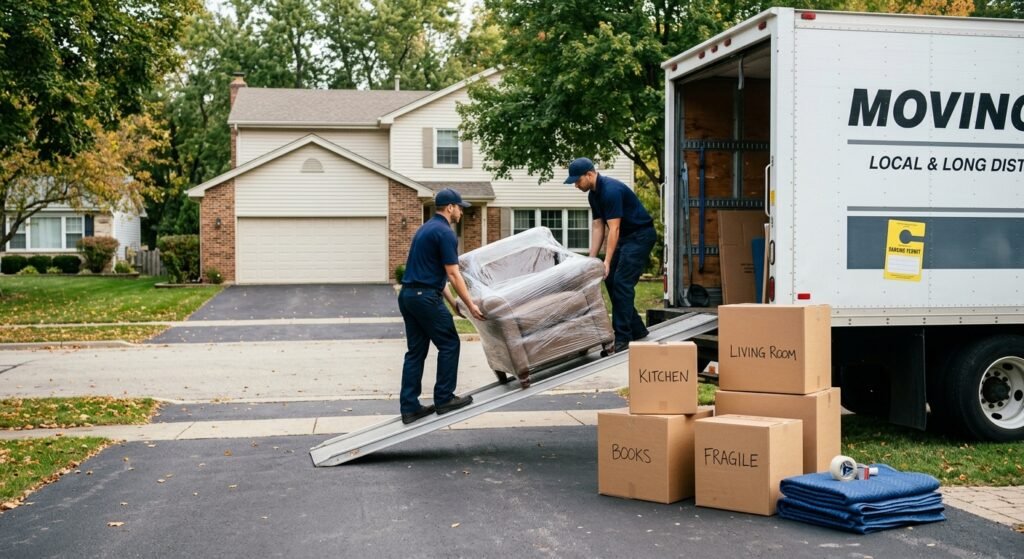
What Counts as a Local Move in Skokie, IL?
A local move is generally defined as a relocation of under 50 miles that stays within the same state, which covers nearly every move happening within or around Skokie. I rely on this distinction constantly because it changes everything about how a move gets priced and regulated.
Long-distance moves fall under federal weight-based pricing rules enforced by the Federal Motor Carrier Safety Administration, while local moves are priced hourly and regulated at the state level instead. This matters for Skokie residents moving to nearby suburbs like Evanston or Niles, since those relocations still qualify as local despite crossing town lines.
Local vs. Long-Distance Mileage Thresholds
Most moving companies set the local-move cutoff at 50 to 100 miles, though the exact threshold varies by company policy rather than law. I always confirm this number upfront because a move that crosses the threshold gets re-quoted under different pricing rules entirely.
How Movers Calculate Local Moving Rates
Movers calculate local rates using an hourly structure that multiplies crew size by hours worked, plus a flat truck fee. A two-person crew with a truck commonly runs $100 to $150 per hour in the Chicago suburban market, according to moving industry cost data from Moving.com.
How Suburban Neighborhoods Affect Moving Logistics
Suburban layouts introduce access challenges that urban moves rarely face, from long driveways to HOA-restricted parking windows. I plan around these details before the truck ever leaves the lot, because a locked gate or towed truck turns a four-hour move into an eight-hour one.
Single-family homes with attached garages, finished basements, and backyard sheds mean more total belongings to move compared to a typical apartment, which extends load time regardless of distance.
Driveway, Cul-de-Sac & HOA Access Considerations
Narrow driveways and tight cul-de-sacs force larger trucks to park on the street, adding a shuttle step that lengthens the whole timeline. Homeowners association rules sometimes restrict moving truck hours or require advance notice, so checking those bylaws two weeks out avoids a same-day surprise.
Street Parking Permits and Truck Placement Rules
Some Skokie streets require a temporary parking permit for any vehicle over a certain length, which the village issues through its public works office. Securing that permit ahead of time keeps the truck legally parked directly in front of the house instead of a block away.
Items Movers Cannot Legally Transport
Movers cannot legally transport hazardous materials, perishable goods, or living items under federal and state transportation regulations. Prohibited items generally include flammable liquids, corrosive chemicals, perishable food, plants, and pets, because these pose safety risks inside an enclosed moving truck.
| Category | Examples | Why It’s Restricted |
| Flammable materials | Propane tanks, gasoline, fireworks | Fire risk in enclosed truck |
| Corrosive chemicals | Pool chemicals, pesticides, acids | Leak and contamination risk |
| Perishables | Frozen food, fresh produce | Spoilage, odor, pest risk |
| Living items | Plants, pets, fish | No climate control or ventilation |
| High-value items | Cash, jewelry, important documents | Liability limits, theft risk |
Hazardous and Flammable Materials
Propane tanks, aerosol cans, and gasoline-powered equipment top the list of items every mover refuses to load, per guidelines from the American Moving and Storage Association. I tell customers to drain gas-powered tools and transport propane tanks separately in their own vehicle.
Perishable and Living Items
Fresh and frozen food rarely survives a multi-hour move without proper refrigeration, so movers decline to pack it for liability reasons. Pets and plants fall into this same category since trucks lack climate control and ventilation suited for living things.
High-Value Items Requiring Special Declaration
Cash, jewelry, and important documents fall outside standard valuation coverage, meaning movers won’t accept liability if they go missing. I recommend customers transport these items personally rather than placing them on the truck at all.
Packing Requirements for a Smooth Local Move
Movers require sturdy, properly sealed boxes with clear labeling to accept liability for the contents during transport. Packing requirements typically include using boxes rated for the item’s weight, sealing seams with packing tape, and avoiding overfilled or underfilled containers that collapse under stacking pressure.
Boxing Standards Movers Require
Double-walled boxes handle books and dense items better than standard single-wall boxes, which tend to bottom out under heavy loads. Movers generally ask that boxes weigh no more than 50 pounds each so crew members can lift them safely without strain.
Labeling and Inventory Systems
Labeling each box by room and contents speeds up both loading and unloading, since crew members know exactly where each item belongs without asking. A simple numbered inventory list matched to a labeled box diagram prevents items from getting lost between two suburban addresses.
Preparing Furniture and Large Items for Transport
Large furniture needs disassembly and protective wrapping before movers load it, which prevents scratches, structural damage, and wasted truck space. I walk customers through this step because furniture prep is where most moving-day damage claims originate.
- Remove drawers and shelves from dressers and bookcases to reduce weight and prevent shifting
- Disassemble bed frames, table legs, and sectional sofas ahead of moving day
- Wrap mirrors, glass tabletops, and artwork in moving blankets or bubble wrap
- Secure loose cushions and pillows in labeled bags rather than loose in the truck
- Photograph electronics setups before disconnecting cables for easy reassembly
Disassembly Expectations
Most moving crews disassemble large furniture on-site as part of standard service, though some companies charge an added fee for extensive disassembly work. Confirming this detail during the quote stage avoids a surprise charge on moving day.
Protective Wrapping Standards
Moving blankets, shrink wrap, and corner protectors are the standard materials movers use to prevent scuffs during transport. Upholstered furniture typically gets shrink-wrapped to guard against dirt and moisture during the loading process.
Moving Day Timeline for a Suburban Local Move
A typical local suburban move takes four to eight hours from load to unload, depending on home size, crew size, and access difficulty. I set this expectation early because underestimating the timeline is the single biggest source of moving-day frustration.
What Affects Load and Unload Time
Stairs, long carry distances from the truck to the front door, and the total volume of belongings all extend the timeline beyond a standard estimate. Homes with detached garages or finished basements routinely add an extra hour or two compared to a similarly sized home without those spaces.
Insurance, Liability, and Valuation Coverage
Moving companies are required to offer valuation coverage, which determines how much they’ll reimburse for damaged or lost items during transport. Valuation coverage is the mover’s built-in liability protection, and it comes in two main forms that differ significantly in payout amount.
| Coverage Type | Reimbursement Basis | Typical Cost |
| Released Value Protection | $0.60 per pound per item | Included free |
| Full Value Protection | Full replacement or repair cost | Added percentage of move cost |
Released Value vs. Full Value Protection
Released Value Protection reimburses damaged items at a flat $0.60 per pound, which rarely covers the true replacement cost of anything valuable. Full Value Protection costs extra but reimburses the full repair or replacement value, making it the stronger option for higher-value households.
What Damage Claims Typically Cover
Damage claims typically cover items broken or scratched during loading, transit, or unloading, provided the damage gets documented before the crew leaves. I always recommend photographing furniture and electronics before the move starts so any dispute has a clear before-and-after record.
Cost Factors Specific to Local Suburban Moves
Local suburban moves in the Chicago area typically cost $400 to $1,200 for a two-to-three bedroom home, based on crew size and total hours worked. Several add-on factors push that baseline higher depending on the specifics of a given property.
Hourly Rate Structures
A three-person crew with a truck commonly bills at $150 to $200 per hour in the greater Chicago suburban market. Larger homes requiring a fourth crew member see that rate climb accordingly.
Common Add-On Fees
Stair fees, long-carry fees, and bulky-item surcharges are the most common additions that push a quote above the base hourly rate. Packing materials and full-service packing labor also add separately itemized costs beyond the moving crew’s time.
Choosing Between Full-Service and Partial-Service Moving
Full-service moving includes packing, loading, transport, and unloading, while partial-service moving limits the crew’s role to loading and transport only.
| Service Type | What’s Included | Best For |
| Full-Service | Packing, loading, transport, unloading, unpacking | Busy households, large homes |
| Partial-Service | Loading, transport, unloading only | Budget-conscious movers, smaller homes |
Choosing between the two comes down to time versus budget. Families juggling work and kids often find full-service worth the added cost simply to avoid the packing workload entirely.
Seasonal and Scheduling Considerations in Skokie
Summer months between May and September see the highest moving demand in the Chicago suburbs, driven by school calendars and favorable weather. Peak season means higher rates and tighter availability, so booking even a local move several weeks ahead protects against scheduling conflicts.
Peak Moving Months and Booking Lead Time
Booking four to six weeks ahead during peak season secures a preferred date, while off-season moves between October and April often allow booking with just one to two weeks’ notice. Winter moves also tend to run cheaper, since demand drops significantly once the weather turns cold.
Moving with Children, Pets, or Elderly Family Members
Moving with kids, pets, or elderly family members adds logistical steps that a standard move doesn’t require, from childcare coverage to medication transport planning.
- Arrange childcare or a sitter for moving day so kids aren’t underfoot during loading
- Board pets or keep them in a quiet, closed-off room away from the open front door
- Pack a clearly labeled “first day” box with medications, documents, and essentials for elderly family members
- Confirm accessibility needs at the new home, including ramps or stair-free entry points
Commercial and Office Local Moves in Suburban Settings
Office relocations require coordination around business hours, IT infrastructure, and equipment handling that residential moves don’t involve. A commercial local move typically needs more advance planning than a residential move because downtime directly affects revenue.
Equipment and IT Infrastructure Handling
Servers, networking equipment, and specialized office machines often require dedicated handling separate from general furniture and boxes. I recommend having IT staff disconnect and label all cabling before the moving crew touches any equipment.
After-Hours and Weekend Scheduling for Businesses
Scheduling the move for evenings or weekends keeps business operations running without interruption during normal hours. Many Skokie office movers offer this scheduling flexibility specifically to minimize disruption for commercial clients.
Common Moving-Day Delays and How to Avoid Them
Moving-day delays most often come from unprepared boxes, blocked driveways, or last-minute item sorting that should have happened before the crew arrived.
- Finish all packing the night before rather than during the move itself
- Clear driveway and street parking access ahead of the truck’s arrival time
- Sort prohibited items out separately so the crew doesn’t pause to question them
- Confirm elevator or hallway reservations in advance for any condo or townhome moves
Conclusion
Local suburban moves hinge on understanding mileage classifications, prohibited items, packing standards, and realistic timelines. Skokie’s neighborhood layouts add access considerations that shape planning decisions beyond simple distance.
We’ve covered the full scope here, and deeper resources exist for packing specifics, insurance details, and commercial move planning within this cluster.
We handle these suburban logistics daily. ASHER MOVERS LOCAL & LONG DISTANCE is ready to make your Skokie move smooth, prepared, and on schedule.
Frequently Asked Questions
What items are movers not allowed to pack?
Movers cannot pack hazardous materials, perishable food, plants, or pets due to safety and liability regulations. This includes propane tanks, gasoline, pool chemicals, and frozen goods. Cash and jewelry are also excluded from standard coverage.
How far in advance should I book a local mover in Skokie?
Booking four to six weeks ahead is recommended during peak summer season. Off-season moves between October and April often only need one to two weeks’ notice. Earlier booking secures better scheduling flexibility.
Do I need insurance for a local move?
Movers are required to offer valuation coverage, but it’s not the same as full insurance. Released Value Protection comes free but pays very little. Full Value Protection costs more and covers actual replacement value.
How much does a local move typically cost?
Local suburban moves in the Chicago area typically run $400 to $1,200 for a two-to-three bedroom home. Costs depend on crew size, hours worked, and add-on fees. Stairs and long carries increase the total.
Can movers transport plants or pets?
No, movers cannot transport plants or pets due to ventilation and climate control limitations in trucks. These items need separate transportation by the customer. This protects both the items and the moving company’s liability.
What should I do with items movers won’t take?
Items movers won’t take should be transported personally in your own vehicle or disposed of properly before moving day. This includes hazardous materials, perishables, and high-value items like jewelry. Sorting these out early prevents moving-day delays.
How long does a typical local suburban move take?
A typical local suburban move takes four to eight hours from load to unload. Home size, crew size, and access difficulty all affect this timeline. Stairs and long carry distances commonly add extra time.
