
Divorce is a legal and emotional process, and it almost always comes with a physical one too: someone has to pack up, divide a household, and move. A divorce-related move involves dividing shared property between two households while coordinating logistics, timelines, and sometimes court-ordered deadlines, which makes it more complex than a standard relocation. I’ve worked with enough families in this exact situation to know the moving part often gets planned last, even though it shapes how smoothly everything else goes.
Rushing this move creates real problems. Items get damaged, disputes resurface, and deadlines get missed when nobody planned the logistics early.
This guide covers what makes divorce moves differently, how settlements shape who gets what, practical strategies for dividing furniture and shared belongings, packing and documentation requirements, and how to handle kids’ items, budgets, and storage when things aren’t fully decided yet.
Why Divorce Moves Are Different From Standard Moves
Divorce moves differ from standard moves because they require dividing one household into two while managing legal timelines, financial strain, and unresolved decisions about who keeps what. I’ve seen couples try to treat it like a regular move and get blindsided by how many small decisions pile up.
A normal move has one point of contact and one destination. A divorce move often has two people who disagree, two new addresses, and a court case running in the background.
Emotional and Logistical Complexity
Splitting a home means touching shared memories, not just furniture, and that slows decisions down even when everyone wants to move fast. We see this constantly the logistics stall because the emotional sorting hasn’t happened yet.
Separating who gets what before the movers arrive prevents arguments on moving day itself.
Timing Pressures From Legal Proceedings
Court dates, custody hearings, and settlement deadlines often dictate when a move has to happen, regardless of readiness. This timing pressure is one of the biggest reasons divorce moves run into trouble.
Waiting until the last minute to book movers during a legal deadline crunch limits your options and raises costs.
How Courts and Settlements Determine Who Gets What
A divorce settlement or court order is the legal document that specifies which spouse retains ownership of which shared property, including furniture, vehicles, and household goods. I always tell clients to get this in writing before moving day, not after.
Verbal agreements fall apart under stress. A written list prevents a disagreement from turning into a delay.
Property Division Orders and Moving Timelines
When a judge issues a property division order, it typically includes a timeframe for each party to collect or relocate their designated items. Missing that window can create legal complications beyond just logistics.
I recommend building in a buffer of several extra days beyond the court deadline for the actual physical move.
What Happens When Terms Are Still Being Negotiated
Negotiated settlement terms frequently change up until the final signature, which means moving plans sometimes need to flex alongside them. This is where a lot of families get stuck.
Mediated property division often moves faster than litigated division, since both sides agree on terms before the moving truck is ever booked.
Creating a Household Division Inventory Before Moving Day
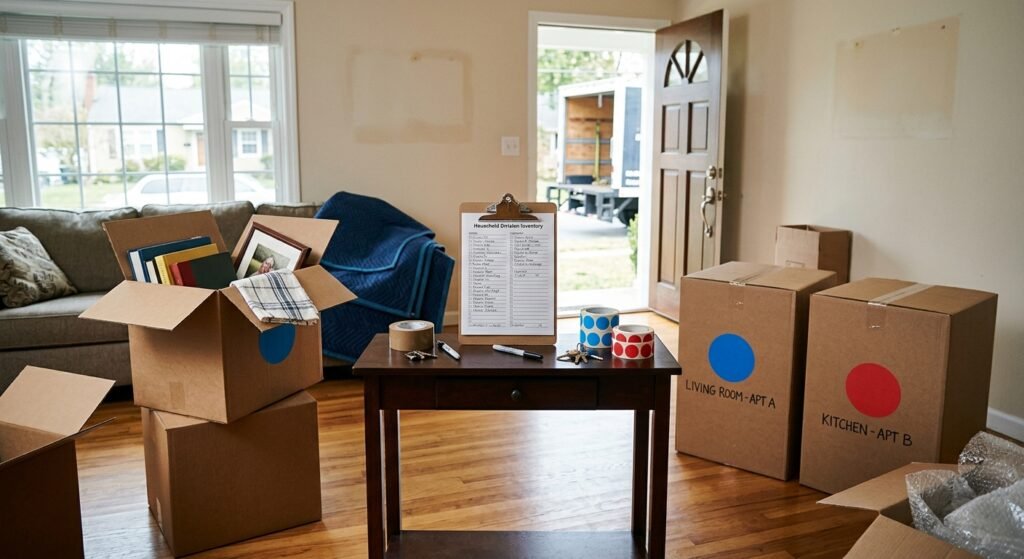
A household division inventory is a documented list of every shared item, who it’s assigned to, and its current condition, created before packing begins. This single document prevents more arguments than any conversation will.
I’ve watched inventories save relationships from turning a move into a second legal battle. It’s worth the few hours it takes to build one properly.
Cataloging Shared vs. Individual Property
Separating shared marital property from items either spouse owned before the marriage is the first sorting step, and it’s rarely as obvious as it sounds. Gifts, inheritances, and pre-marriage purchases all complicate this category.
| Property Type | Typical Treatment | Common Dispute Point |
| Pre-marriage personal items | Usually retained by original owner | Mixed storage with shared items |
| Jointly purchased furniture | Divided per settlement terms | High sentimental or resale value |
| Gifts to one spouse | Usually retained by recipient | Proof of original gift intent |
| Shared electronics/appliances | Divided or one party buys out the other | Functional vs. matched sets |
This table shows how property type typically determines who keeps an item and where disputes tend to surface.
Photographing and Documenting Condition
Taking dated photos of each item before it’s packed protects both parties if a dispute arises later about condition or ownership. I never skip this step, even on moves that feel entirely amicable.
A simple phone photo with a timestamp holds up far better than a memory does six months later.
Splitting Furniture and Large Household Items
Large furniture is usually the hardest category to divide because pieces are often purchased as matched sets or serve a shared household function. The furniture dividing process works best when both parties agree on a method, such as alternating picks or appraised buyouts, before movers show up.
I’ve seen moving day grind to a halt because a couch hadn’t been assigned to anyone yet.
Dividing Matched Sets and Pairs
Bedroom sets, dining sets, and matching sofas create a specific problem: splitting them devalues both halves. One workable solution is letting one spouse keep the full set while compensating the other through a different asset.
Breaking up a matched set rarely satisfies either party as much as a clean trade does.
Deciding Who Keeps Shared Big-Ticket Items
High-value items like a refrigerator, washer and dryer, or home theater system often require a buyout agreement rather than a straight split. I recommend getting a replacement cost estimate before negotiating who keeps what.
A quick appraisal conversation upfront prevents a resentful argument three weeks into the new place.
Dividing Shared Belongings Fairly and Efficiently
A room-by-room division strategy sorts shared belongings systematically by physically walking through each space of the home and assigning items as you go. This beats trying to divide an entire house from memory or a spreadsheet.
I walk clients through this because it surfaces items people forget they even own until they’re standing in front of them.
Room-by-Room Division Strategy
Starting with lower-conflict rooms like the garage or linen closet builds momentum before tackling emotionally loaded spaces like a shared office or nursery. Save the hardest rooms for when both people are calmest, not first thing in the morning.
This order matters more than people expect going in.
Handling Sentimental and Disputed Items
Photos, heirlooms, and gifts from family members create disputes that have nothing to do with monetary value. These items often need a separate conversation, sometimes with a mediator, outside the general division process.
Disputed sentimental items set aside in neutral storage until resolved tend to cause far less friction than forcing a decision on moving day.
Packing Requirements for a Divorce-Related Move
Packing for a divorce move follows the same transportation rules as any move, but with the added complexity of sorting items for two separate destinations at once. Professional movers cannot transport hazardous materials, perishable food, or items without a clear destination assignment, which makes pre-move sorting essential.
I always ask clients to finish division decisions before the packing crew arrives, not during.
What Movers Can and Cannot Transport
Movers are restricted from transporting flammable liquids, propane tanks, firearms without proper documentation, and perishable goods, regardless of whose household they’re headed to. This restriction list doesn’t change just because it’s a divorce move.
| Category | Examples | Transport Status |
| Hazardous materials | Propane, paint thinner, gasoline | Not transportable |
| Perishables | Fresh food, frozen goods | Not transportable |
| Firearms | Handguns, rifles | Requires separate documentation |
| Valuables/documents | Cash, deeds, jewelry | Recommended to transport personally |
This table outlines what falls outside standard mover liability and what requires personal transport instead.
Labeling Systems for Two Separate Destinations
Color-coded labels tied to each household’s new address prevent boxes from ending up at the wrong location. A simple two-color system, applied consistently to every box, resolves most mix-up risk before it happens.
I’ve seen entire moves run smoothly just because labels were color-matched to address, nothing more complicated than that.
Coordinating Two Separate Delivery Addresses
Splitting a move into two delivery addresses means scheduling either two separate trucks or one truck with sequential stops, both of which affect cost and timing. This decision usually comes down to how much is going to each location.
I walk every divorce-move client through both options before they commit to either.
Scheduling Logistics for Split Deliveries
Sequential delivery stops work when both new addresses are reasonably close together, since the truck simply unloads at one stop before continuing to the next. Separate trucks make more sense when addresses are far apart or timing needs to happen simultaneously.
Simultaneous delivery avoids the awkwardness of one spouse waiting around at the old place while the other receives their items first.
Cost Implications of Dual Destinations
Splitting a move into two deliveries typically costs more than a single-destination move, since it usually requires either extra mileage, additional labor time, or two separate crews. Budgeting for this ahead of time avoids a surprise on the final invoice.
Getting a written estimate that accounts for both stops prevents disputes over who owes what portion.
Moving Timeline Considerations During Divorce Proceedings
A divorce move timeline needs to account for legal deadlines, lease or closing dates, and the time it takes to physically divide a household before packing can even start. Rushing any one of these creates pressure on the others.
I generally recommend starting the division conversation at least four to six weeks before a target move date.
Aligning Move Dates With Legal Deadlines
Court-imposed deadlines for vacating a shared residence sometimes leave little room for a full division process, which means prioritization becomes necessary. Decide what moves first and what can follow in a second trip if needed.
A phased move, with essentials going first, often works better than trying to finish everything in one day under deadline pressure.
Children’s Belongings and Custody-Related Moving Needs
Packing for a two-household custody arrangement means duplicating or dividing children’s essentials so each home has what kids need without constant back-and-forth transport. This is one of the most overlooked parts of a divorce move.
I always ask parents to think about this separately from the general household division, since kids’ needs don’t follow the same logic as furniture.
Packing for Two-Household Custody Arrangements
Duplicate sets of basics like toiletries, chargers, and a few favorite toys at both homes reduce the number of items that need to travel between households each week. This small investment upfront saves constant shuffling later.
Clothing usually needs to travel with the custody schedule rather than being permanently split between homes.
Minimizing Disruption to Kids’ Routines
Keeping a child’s bedroom setup similar in both new homes, even down to bedding or wall color, helps reduce the disorientation that comes with two new living spaces. Kids notice more than parents expect during a move like this.
Consistent bedtime routines, maintained across both households during the transition, matter more to kids than how matching the furniture looks.
Documenting Item Condition and Ownership for Protection
Documenting ownership and condition before a divorce move protects both parties if a dispute arises later over who owned an item or what state it was in. I treat this step as non-negotiable on every divorce move I help plan.
A folder of photos and receipts takes an afternoon to assemble and can prevent months of disagreement.
Why Documentation Matters for Liability and Disputes
Movers carry liability for damage that occurs during transport, but that liability depends on documented pre-move condition. Without it, proving when damage occurred becomes difficult for everyone involved.
Pre-move condition reports, created with photos and brief notes, give both spouses and the moving company a clear reference point if anything gets questioned afterward.
Working With Moving Companies During a Divorce
Moving companies handle divorce moves regularly, and being upfront about the situation helps the crew plan for two destinations, extra sorting time, or sensitive timing needs. I’ve found that movers appreciate the heads-up far more than clients expect.
Hiding the complexity from the mover almost always backfires on moving day itself.
What to Disclose to Your Mover
Telling your mover in advance that items are split between two addresses, or that one spouse won’t be present, lets the crew plan logistics instead of improvising on-site. This single conversation prevents most day-of confusion.
A pre-move walkthrough call with the mover resolves questions that would otherwise surface awkwardly in front of both spouses.
Avoiding Delays Caused by Unresolved Disputes
Movers cannot resolve ownership disputes on moving day, and an unresolved disagreement over a specific item can stall the entire crew. Finalizing the inventory before the truck arrives avoids this entirely.
Unresolved item disputes on moving day often mean the disputed piece simply stays behind until it’s settled, which delays the broader timeline.
Budgeting for a Divorce-Related Local Move
Budgeting for a divorce move means accounting for potentially two delivery locations, possible storage fees, and the standard costs of packing and labor. Divorce moves typically cost more than a comparable single-household move due to this added complexity.
I encourage clients to get a written estimate early, before emotions make cost conversations harder than they need to be.
Splitting Moving Costs Between Parties
Settlement agreements sometimes specify how moving costs get divided, but when they don’t, couples generally split based on the proportion of items each person is taking. Agreeing on this before booking avoids a dispute over the final invoice.
A simple percentage split, documented in writing, heads off most billing disagreements.
Storage Solutions When Division Isn’t Finalized
Short-term storage holds items that haven’t been assigned to either household yet, which keeps undecided property out of either person’s living space during negotiations. This option takes pressure off a moving day deadline when terms aren’t settled.
I recommend storage far more often than people expect, simply because it removes the rush.
Short-Term Storage for Disputed Items
A neutral storage unit, paid for jointly or per the settlement terms, holds disputed items until both parties or a mediator reach a final decision. This keeps contested property out of either new home entirely.
Neutral storage arrangements prevent one spouse from gaining possession simply because an item ended up in their truck.
Common Mistakes People Make When Moving During Divorce
The most common mistake in a divorce move is starting the physical packing before the division decisions are finalized, which forces last-minute arguments during an already stressful day. I see this one more than any other.
Rushing division to meet a moving date backfires almost every time.
Overlooking Documentation and Rushing Division
Skipping photos and written inventories feels like saving time, but it usually costs more time later resolving disputes that documentation would have prevented. This mistake is entirely avoidable with a few hours of preparation.
Rushed division decisions, made under moving-day pressure, are the ones most likely to get revisited and disputed afterward.
Emotional Preparation for Moving Day
Moving day during a divorce carries emotional weight that a standard move doesn’t, since it often marks a concrete, physical end point to the relationship. I tell clients to plan for this emotionally, not just logistically.
Having a friend or family member present, rather than facing the day entirely alone, makes a measurable difference for a lot of people.
Arranging separate arrival times for each spouse, when possible, reduces the chance of an emotional moment turning into a logistical delay.
Conclusion
Dividing a household during divorce means balancing legal timelines, fair division, and careful packing all at once. We’ve walked through inventories, splitting furniture, custody logistics, and documentation that protect both parties through the process.
ASHER MOVERS LOCAL & LONG DISTANCE handles divorce moves across Skokie with the sensitivity and logistics expertise this transition demands. Reach out and we’ll help you plan a smoother split.
Frequently Asked Questions
How do movers handle splitting a household during divorce?
Movers typically coordinate two delivery addresses or sequential stops based on a finalized division inventory provided before moving day. They rely on clear labeling and advance planning to keep items separated correctly.
Who decides which items go to each household?
A court-ordered settlement or a mutual agreement between spouses determines which items go to each household. Without either in place, movers cannot resolve ownership disputes on-site.
Can one spouse schedule a move without the other’s consent?
A spouse can generally schedule a move for their own designated items without the other’s consent, as long as those items are already assigned through a settlement or agreement. Shared or disputed items usually require mutual sign-off first.
What items are movers not allowed to transport?
Movers are not allowed to transport hazardous materials, perishable food, and firearms without proper documentation, regardless of the moving situation. These restrictions apply the same way to divorce moves as any other.
How far in advance should we book a divorce-related move?
Booking four to six weeks in advance gives enough time to finalize division decisions before packing begins. Shorter timelines are possible but increase the risk of unresolved disputes on moving day.
What if we can’t agree on who gets what before moving day?
Disputed items can go into short-term neutral storage until both parties or a mediator reach a final decision. This keeps the move on schedule without forcing a rushed agreement.
Do movers charge more for splitting items into two locations?
Splitting a move into two delivery locations typically costs more than a single-destination move due to added mileage, labor time, or a second crew. Getting a written estimate that covers both stops avoids billing surprises.
